
6 e-learning trends for 2026
As an online trainer (or training manager), it is worth keeping these e-learning trends on your radar, as they are already influencing how courses are designed, delivered and assessed in 2026.
The major difference compared with previous years is that Artificial Intelligence within the learning ecosystem has moved beyond being a “novelty” and become part of everyday practice. In other words, it is no longer simply an add-on: it has become the driving force behind personalised learning and advanced data analysis.
Artificial Intelligence will therefore continue to transform how we learn and teach online, but it will not be the only force driving change. Other trends, including blended learning, microlearning, immersive learning experiences, advanced gamification and learning chatbots, are gaining momentum as the need to place learners at the centre and meet their training needs through more flexible, modular pathways becomes increasingly urgent.
The sector is also moving towards models that combine technology with human connection: learning in the flow of work, deep personalisation, new skills (power skills) and active methodologies that encourage learners to apply their knowledge immediately in real-world contexts.
Artificial Intelligence

We begin our look at the e-learning trends with Artificial Intelligence, and in 2026 it remains impossible to start anywhere else.
As well as automating administrative and repetitive tasks, Artificial Intelligence is evolving into a central driver of intelligent learning, capable of personalising training pathways, adjusting difficulty levels and providing immediate feedback based on real data about each learner’s performance.
AI-powered systems are gradually becoming more accurate at collecting and analysing information about learners’ progress, making it possible to align training content with their actual needs. This ability to adapt to each learner’s pace, preferences and level results in more motivating, agile and effective experiences.
At the same time, the little bots that provide instant information will remain very much present, answering our questions and offering immediate support.
We are, of course, referring to learning chatbots and virtual assistants, which are becoming essential tools for answering questions, guiding activities and supporting learners throughout their training journey. Beyond ChatGPT, which needs no introduction, new chat-based tools similar to Khanmigo, which supports Khan Academy learners, and the well-known Duolingo bots for language learning will emerge, incorporating generative AI and a deeper contextual understanding of learning. These developments reflect the growing use of chatbots and gamification in training, both of which have been highlighted by digital learning experts.
According to The Insight Partners’ report, “The Spanish Chatbots Market in Education: Trends, Drivers, and Challenges 2023–2027”, the learning chatbot market in Spain will grow at a compound annual growth rate of 20%, reaching €40 million by 2027, with global forecasts showing similarly strong growth.
Forecasts from Global Market Insights also suggest that the Artificial Intelligence market in learning and training will exceed $80 billion by 2030, with a compound annual growth rate of 20% between 2023 and 2032, driven by demand for personalised learning and the increasing use of mobile devices.
In 2026, Artificial Intelligence will not only personalise content: it will also be naturally integrated into connected blended learning ecosystems, helping to automate internal processes, provide advanced analytics and create more coherent, human-centred learning experiences, in line with current approaches to more conscious and purposeful blended learning.
Recommendations
- Artificial Intelligence is on your side and can help you. Do not see it as a threat.
- Learn how to use Artificial Intelligence. According to the Ipsos Global Education Monitor, which examines the importance of training teaching professionals to use AI, 65% of respondents across 29 countries believe that trainers should receive AI training to improve their learning strategies. This need is closely aligned with the growing demand for digital and cognitive skills in the age of generative AI.
- Explore and try out AI tools for trainers. They can help you optimise your training methods and adapt content to your learners. These technologies are ideal for instructional designers and L&D managers and form part of the key e-learning trends for 2026, particularly in areas such as microlearning, automation and advanced gamification. The goal is no longer simply to deliver classes, but to create effective training catalogues in record time. To make the most of them, take a look at our selection of essential e-learning tools.
- AI is not human, and it will not replace your work. Providing emotional support, showing empathy and encouraging learners to take part in creative and engaging sessions remain your responsibility. Although AI can automate and personalise learning, current training trends emphasise that human connection and emotional wellbeing must remain priorities. A trainer’s empathy, motivation and active guidance will continue to be irreplaceable in the learning environments of the future.
- Set aside time to keep up to date with developments in AI. Technological progress is rapidly transforming the training landscape, and 2026 is expected to bring even greater integration of AI into training, administrative and methodological processes, particularly within connected blended learning ecosystems.
- Help your learners develop both human and digital skills. As well as encouraging them to strengthen skills such as critical thinking, creativity and collaboration, teach them how to use AI responsibly and ethically. Whether we like it or not, Artificial Intelligence will be present in their personal and professional lives, making it essential for them to understand it and apply it with sound judgement.
Hybrid learning or blended learning
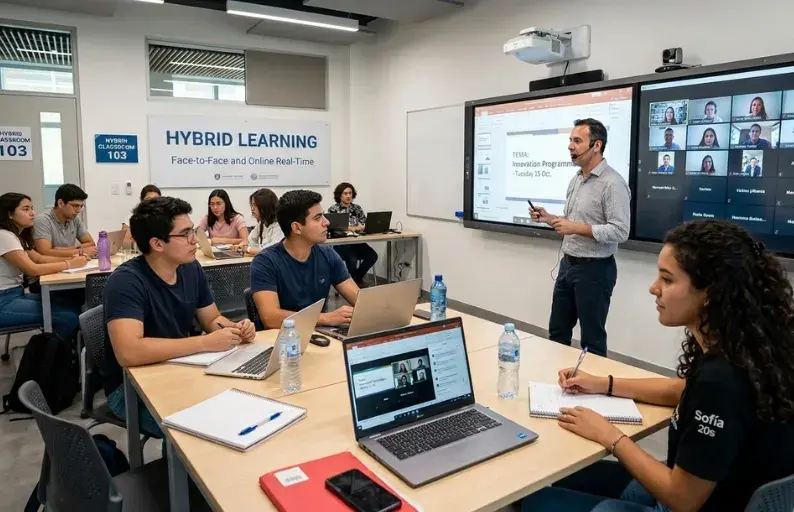
In recent years, we have seen training move towards an increasingly personalised, flexible and learner-centred approach. In a corporate setting, for example, a blended learning model allows a new employee to become familiar with the company culture in person while completing technical processes independently through an LMS. This is in addition to the number of learners who can be trained at the same time and the other advantages of e-learning over face-to-face training.
In 2026, this trend is becoming even more firmly established. Blended learning is positioning itself as one of the most effective training models because it can adapt more closely to each person’s lifestyle, pace and needs. A blended learning model makes it possible to extend the reach of training, improve accessibility and optimise learning time.
It also fits with the shift towards cyber-physical environments, where digital and face-to-face elements are seamlessly integrated to create richer, more connected experiences.
We have seen this growth first-hand. For example, the Chilean Olympic Committee used blended learning to train 20,000 volunteers for the 2023 Pan American Games. Thanks to this model and the features of our e-learning platform, they were able to complete the training in just a few months, something that would have been impossible using face-to-face sessions alone.
Blended learning is continuing to gain momentum and is expected to grow further over the coming years. This trend reflects the global shift towards smart classrooms, microlearning, immersive learning and AI-powered personalisation, which are shaping the training landscape in 2026.
El aprendizaje híbrido está en pleno auge y se prevé que siga creciendo durante los próximos años. Esta tendencia coincide con el impulso global hacia aulas inteligentes, microaprendizaje, aprendizaje inmersivo y personalización mediante IA, que dominan el panorama educativo en 2026.
Recommendations
- Taking a learner-centred approach means recognising that people absorb and process information in different ways. Content should therefore be varied, relevant and adaptable, responding to individual preferences and allowing learners to progress independently. This need for flexibility and adaptability is one of the key e-learning trends for 2026, with a growing focus on more human, personalised learning built around modular training pathways.
- Allow your learners to choose how they want to learn, whether online or face to face, and provide them with the right experiences, resources and support. This increases both motivation and training effectiveness. The approach also reflects the growth of models that combine digital and physical environments within connected cyber-physical settings, one of the most prominent trends for 2026.
Microlearning and mobile learning
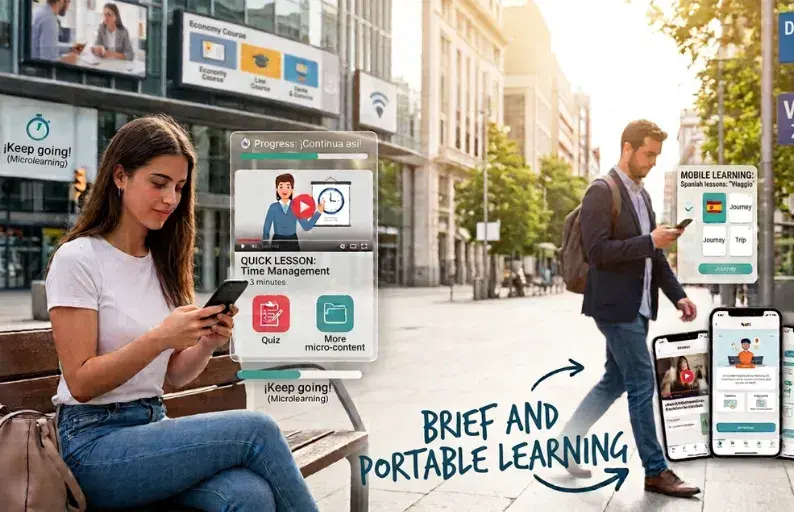
Microlearning has long since proved that it is here to stay and continues to rank among the leading e-learning trends, partly because it delivers intensive, concise and engaging training. In 2026, this format continues to grow thanks to its effectiveness in improving retention, encouraging independent learning and fitting around the limited time available to learners and professionals. The continued development of microlearning as a key feature of today’s e-learning landscape confirms this shift.
Long blocks of content, lengthy units and extensive topics are being left behind. The focus is now on delivering material through short, targeted modules and lessons, each centred on a specific objective. Remember that we are living in an age of instant, fragmented information, so the aim is essentially to adapt to this preference.
Interactive microlearning has evolved into a concise, dynamic and highly participative form of interactive learning. Ultra-short videos, similar to Reels or Shorts, communicate key ideas in seconds; quick, adaptive quizzes reinforce concepts immediately; and micro-challenges or bite-sized activities allow learners to apply what they have learnt straight after viewing the content. These brief, immediate and actionable interactions fit seamlessly into busy routines without compromising the quality of the training.
At the same time, the rise of vertical digital content has driven the growth of mobile learning and the creation of content optimised to be viewed directly on a mobile device. Fast-paced editing captures attention within the first few seconds, while concise storytelling inspired by TikTok-style vertical learning makes learning feel more natural and accessible to people who are already familiar with this format.
This is also where nanolearning comes into play. In 2026, there is growing use of ultra-short pieces of content designed to help people learn “in a single gesture”, particularly through mobile devices and wearables.
Recommendations
- Design modular courses with short lessons focused on clear objectives. This approach makes knowledge easier to absorb quickly and allows learners to progress at their own pace. It is closely aligned with the growth of microlearning and flexible learning, which continue to shape the e-learning trends of 2026.
- Engagement and participation should be built into the structure of every module. Include short activities, challenges, interactive elements or small doses of gamification, as these formats are becoming increasingly popular and can significantly improve learner engagement.
Immersive learning

When we talk about immersive learning, we are referring to a trend that uses technologies such as virtual reality (VR), augmented reality (AR) and mixed reality (MR) to create more practical, dynamic and memorable training experiences.
On the one hand, Virtual Reality (VR) immerses learners in realistic virtual environments, making it ideal for practising procedures or skills without risk. On the other, Augmented Reality (AR) enhances the physical world with interactive digital elements, making complex concepts easier to understand. Finally, Mixed Reality (MR) combines both approaches.
All these technologies allow learners to explore environments in a practical way, improving retention and participation.
Training confined exclusively to the classroom is now a thing of the past. Today, more dynamic learning environments connected to real-life situations are taking centre stage, allowing knowledge and practice to be integrated more effectively.
In 2026, immersive learning is taking a significant step forward thanks to the introduction of professional VR- and AR-based simulations enhanced by Artificial Intelligence.
These simulations make it possible to recreate realistic, safe scenarios for technical, healthcare, industrial and customer service training. They allow learners to practise complex skills without risk and repeat processes as many times as necessary.
Artificial Intelligence adds an additional layer of realism and adaptability: characters respond coherently to learners’ decisions, tasks adjust their level of difficulty according to performance, and alternative pathways are generated automatically based on each user’s interactions. All this transforms immersive learning into a far more personalised, effective and motivating experience, capable of providing immediate, detailed feedback.
At the same time, these technologies make it possible to collect advanced performance data, such as reaction times, interaction patterns and recurring mistakes, helping trainers gain a clearer understanding of learner progress and adjust training more strategically.
Recommendations
- Take an open-minded approach to incorporating these technologies into your remote sessions. In 2026, VR, AR and MR are becoming increasingly integrated into blended learning models and remote laboratories, making them essential tools for creating more practical and realistic immersive learning experiences.
- Explore virtual and augmented reality tools and find creative ways to use them in distance training.
Gamification and interactive learning experiences

Both gamification and interactive learning experiences continue to embody the “learning by doing” approach that is so important in online training.
Gamification has proved particularly effective at motivating learners in remote sessions by incorporating elements such as progress bars, leaderboards, badges, medals and other game-based mechanics that make lessons feel fresher and encourage healthy competition.
In 2026, this approach is evolving into a smarter, more dynamic model, in which Artificial Intelligence automatically adjusts challenges, levels and rewards according to each learner’s actual performance. This creates gamified pathways that change as learners progress, encounter difficulties or excel at particular tasks.
At the same time, the social side of learning is becoming increasingly important, with collaborative and competitive gamified experiences that foster a sense of community, such as team challenges and shared missions that enrich interaction between peers.
Tools and activities that enable learners to engage with course content in a more active and participative way will also remain a key part of interactive learning, whether or not they include elements of gamification. These approaches make learning more enjoyable while helping learners understand concepts and develop practical skills.
Thanks to this evolution, gamification is no longer simply an added feature. It is becoming an intelligent, adaptive and social motivational ecosystem that supports learners throughout their training journey.
Recommendations
- Do not use gamification simply for the sake of it. The aim is to include gamification elements that are genuinely relevant to the course, taking both the learners and the content into account.
- Consider who your learners are and what content they need to engage with when personalising their interactive learning experiences. This may involve adapting difficulty levels, progression, preferences and learning pace. Digital training in 2026 places particular emphasis on deep personalisation and active methodologies that adapt to each learner’s characteristics to improve motivation and engagement.
- Use reports and analytics to monitor their progress and adjust both the content and your training methodology.
Learning agility and AI-powered reskilling

The pace at which the labour market is evolving requires professionals to develop constant learning agility: the ability to acquire new skills and adapt to changing circumstances almost in real time. This need has made learning agility and reskilling key pillars of training in 2026, supported by e-learning platforms that use Artificial Intelligence to identify knowledge gaps, recommend personalised training pathways and anticipate future talent requirements.
In this new landscape, AI acts as a learning companion that analyses performance, recommends content tailored to each learner’s profile and identifies opportunities for improvement before they become a problem. This allows every learner to progress at their own pace while remaining aligned with the organisation’s strategic objectives. AI also makes it possible to measure the real impact and ROI of training by comparing performance before and after reskilling.
Intelligent systems identify the skills that are most relevant to each role, both now and in the future, and design reskilling and upskilling pathways that respond directly to real workplace demands. This enables a far more proactive approach to training, in which learners develop not only the skills they need today, but also those they will need tomorrow.
With this shift, professional development is no longer a reactive process. Instead, it becomes a continuous cycle of growth, in which teams prepare to respond to technological change, new business models and internal transformation with greater confidence and security.
Recommendations
- Promote learning agility by fostering a culture of continuous learning in which updating knowledge becomes a natural part of everyday training.
- Promote learning agility by fostering a culture of continuous learning in which updating knowledge becomes a natural part of everyday training.
- Keep your content alive and up to date: regularly review, adapt and refresh your training materials so that the LMS remains aligned with changes in the sector and any new challenges that may arise.
- Use progress data to identify opportunities for improvement and adjust the pace, level of difficulty or focus of each learning pathway.
Other emerging e-learning trends

Immersive technologies continue to evolve and, in 2026, extended reality (XR), which combines virtual, augmented and mixed reality, is becoming established as one of the most powerful tools for transforming digital learning.
What was once considered experimental is now part of everyday training. Organisations and businesses use XR to recreate complex professional scenarios, provide practical training in safe environments and deliver engaging experiences that improve retention and allow learners to learn by doing. This has become possible because more training providers are using practical simulations and the required technology is now far more accessible and affordable. As a result, VR and AR have moved beyond being promising innovations to become widely used tools in training and immersive learning.
Another key trend is Machine Learning (ML), one of the foundations of Artificial Intelligence in learning. Although it is sometimes confused with other concepts, such as Deep Learning or neural networks, ML stands out for its ability to create tailored experiences by collecting and analysing learner data. For example, when a learner shows a preference for visual content, the system can automatically recommend videos or interactive resources suited to that profile. This level of personalisation reflects the e-learning trends shaping 2026, in which Artificial Intelligence drives intelligent, adaptive and interactive learning.
Machine Learning is particularly relevant because it provides real-time feedback, automates tasks such as marking and recommendations, and supports the creation of content on demand.
Finally, work-based learning (WBL) continues to gain momentum. This model combines formal instruction with practical experience in real workplace environments, making it an ideal way to develop the power skills most sought after in today’s labour market: communication, problem-solving, critical thinking, adaptability and teamwork. The e-learning trends for 2026 highlight the growing importance of these human skills as a central part of the new learning and employability landscape.
The importance of power skills is so significant that recent reports, such as research by Deloitte, predict that by 2030, two-thirds of all jobs will require intensive use of these skills. The report also highlights that power skills will be essential for adapting to the workplace in the age of generative AI, with particular emphasis on creative and analytical thinking as the skills expected to experience the greatest growth. In other words, professionals who develop them will be better prepared for the future.