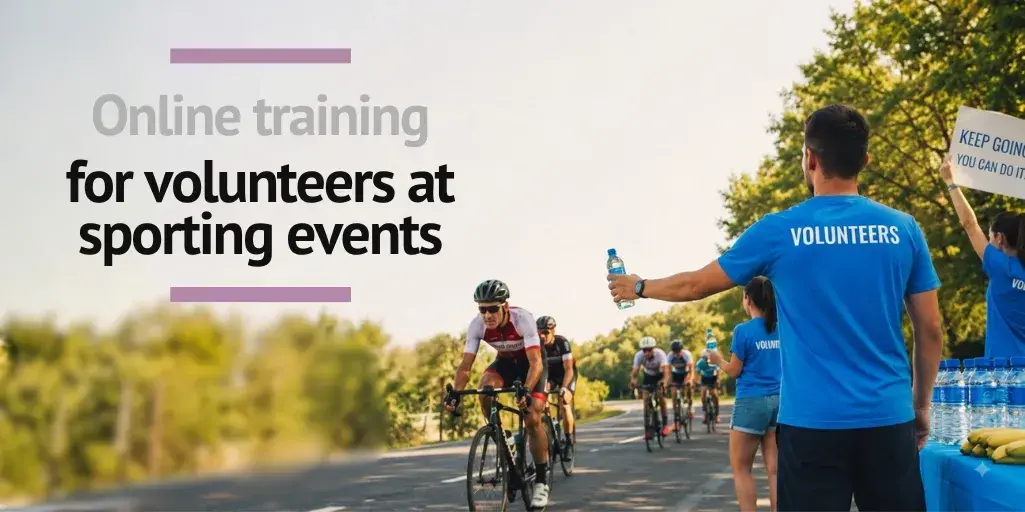
Organising sports event volunteer training involves far more than simply preparing content. When the start date is non-negotiable, thousands of people are spread across different regions and volunteers have a wide range of roles and backgrounds, the real challenge is ensuring that everyone arrives at the event having completed their training, passed the relevant assessments and received their accreditation on time.
It is possible to deliver mass volunteer training to thousands of people across an entire country before a non-negotiable deadline. The key to successful volunteer training at scale is to structure the project in phases and rely on a volunteer training LMS capable of handling enrolment, progress tracking and certification for thousands of participants without losing control of the process.
Organising volunteer training for a large sporting event involves far more than simply preparing content. These events bring together volunteers with a wide range of roles and backgrounds, while their start dates cannot be moved. In this situation, ensuring that everyone arrives at the event having completed their training, passed the relevant assessments and received their accreditation on time can be a genuine challenge.
The good news is that this process can be managed successfully when it is treated as a structured project and supported by a volunteer onboarding platform capable of handling enrolment, progress tracking and certification for thousands of participants. Problems arise when volunteer management for sporting events relies on spreadsheets, emails and manual processes that are no longer viable at scale.
Why sports event volunteer training is one of the biggest risks ahead of a major sporting event

The challenge with mass volunteer training is not creating a course, but ensuring that thousands of people complete their training before a deadline that cannot be pushed back. At a major sporting event, any disruption to this process can have a direct impact on the event’s operations.
Unlike other training projects, there is no scope to postpone training sessions or enrol participants gradually. The opening day is fixed from the outset, and every volunteer must have completed the compulsory learning pathways before that date.
This time pressure is compounded by several other factors that make organising the training considerably more complex:
- Thousands of participants need to be enrolled and given access to the training within a very short period.
- Geographical spread, as volunteers may come from different cities or even different countries.
- Highly diverse profiles, with varying levels of experience and digital skills.
- The need to provide proof of training completion, as many roles require volunteers to demonstrate that they have completed specific content before joining the event operation.
As the numbers grow, the rules of the project change too. What may work when training a hundred people is no longer operationally viable when several thousand are involved. Coordinators can no longer check manually who has accessed the course, who needs a reminder or who has passed the assessment. Nor is it feasible to handle issues solely by email or track progress using spreadsheets that require constant updating.
When organising volunteer training for a large sporting event, such as a national championship, a world championship, a multi-sport competition or any other large-scale event, your greatest concern is probably not creating the content, but being certain that every volunteer will arrive fully prepared on the day of the event.
To make that happen, sports event volunteer training must be designed as an operational project, with scalable processes, continuous monitoring and a technological infrastructure capable of handling thousands of logins and certificates without compromising the learner experience.
The five phases of organising mass volunteer training before the event

The most effective way to organise volunteer training for a large sporting event involving thousands of people is to treat it as a project with clearly defined phases. Each stage has a different objective and requires specific processes to prevent delays, administrative errors or people arriving at the event without having completed their training.
Although every competition has its own particular requirements, most large-scale volunteer training projects in sport follow the same sequence: designing the learning pathway, onboarding participants, monitoring progress, certifying completion and checking that everything is ready before the event begins.
Design a learning pathway that everyone can complete
Successful sports event volunteer training begins long before the first volunteer is enrolled. A learning pathway that is too long, complex or poorly suited to participants’ profiles will increase non-completion rates and lead to more issues in the weeks before the event.
The best approach is to create a straightforward pathway, divided into short modules and designed around a realistic completion time. Rather than placing all the information in a single course, it is more effective to separate the content according to its purpose:
- Mandatory volunteer induction training, shared by all volunteers (welcome, event values, customer service, safety protocols or sustainability).
- Role-specific training, tailored to the role each person will perform (accreditation, logistics, transport, athlete support, communications, etc.).
- Reference materials, available to answer questions without participants having to repeat the training.
Enrol thousands of people without administrative errors
When thousands of volunteers are involved, enrolment must be automated. Creating accounts manually or processing registrations one by one takes an unmanageable amount of time and increases the risk of errors.
Users are usually imported in batches from lists supplied by the organisation or its partners. As well as speeding up the process, a volunteer onboarding platform prevents duplicate records, automatically assigns each participant to the appropriate learning pathway and makes it easier to manage different profiles, such as volunteers, team leaders and area managers.
For projects of this size, it is important to use a volunteer e-learning platform that can automate enrolment and manage thousands of users simultaneously.
Monitor progress without relying on manual follow-up
Coordinators should not spend their working day checking who has logged in to the platform and who has not. Their role is to identify issues and make decisions, not chase participants through individual calls or emails.
To achieve this, progress monitoring should rely on automated workflows within the volunteer training LMS that quickly identify situations such as:
- people who have not yet accessed the course;
- participants who have been inactive for several days;
- outstanding assessments;
- learning pathways approaching their deadline.
This means reminders are sent automatically, allowing the team responsible to focus solely on cases that genuinely require intervention.
In projects involving thousands of participants, using a sports LMS with progress dashboards and intelligent alerts makes it possible to act before delays jeopardise preparations for the event.
Assess knowledge and certify training completion
Training is only complete when the organisation can provide evidence that each volunteer has met the established requirements. It is therefore advisable to define the assessment criteria from the outset—such as the pass mark, compulsory modules or the deadline for completing the pathway—and automate the issuing of certificates once those conditions have been met. This makes it possible to certify volunteers online without adding manual administrative work.
When it is also necessary to prove that certificates are authentic or retain evidence for audits, certificates that can be verified using blockchain technology provide greater traceability and make it easy to confirm their validity, even long after the event has ended.
Confirm that everything is ready before the event opens
Before the event begins, the organisation must be certain that every volunteer is ready to take up their role. The final report should provide a clear overview of the training status, identifying who has completed the pathway, which participants still have outstanding tasks and which issues require action.
Having this information before the event opens supports operational planning, reduces the need for last-minute fixes and allows decisions to be based on data rather than estimates.
What a sports LMS must deliver for volunteer training at sporting events
| Requirement | Why is it important? |
|---|---|
| Scalability | It must support thousands of connected users and peaks in activity without affecting performance. |
| Easy access from any device | Many volunteers will access the platform via mobile devices, and not all of them have the same level of digital skills. |
| Bulk enrolment | Allows users to be imported in batches and automatically assigned to the relevant learning pathways. |
| Monitoring and alerts | Makes it easier to identify dropouts, delays or inactive participants without the need for manual tracking. |
| Assessment and certification with traceability | Ensures that only those who meet the requirements receive their accreditation and allows certificates to be verified afterwards. |
| Exportable reports | Provides up-to-date information to coordinate teams and demonstrate training status whenever required. |
| Support during critical periods | The days leading up to the event involve the highest workload, and any issues must be resolved quickly. |
| Usability | If volunteers encounter difficulties accessing or completing the course, dropouts and support requests will increase. |
What the volunteer onboarding platform can automate—and what still depends on the organising team
A volunteer onboarding platform can automate much of the training management process, but it cannot replace project coordination. Its main contribution is to reduce repetitive tasks so that the organising team can focus on resolving issues, supporting participants and preparing for the event.
In projects involving volunteer training for a large sporting event, the best results are usually achieved when technology handles the administrative processes, while the team takes care of decisions that require judgement, communication or an understanding of the context.
| Task | Can be automated | Requires a coordinator or tutor |
|---|---|---|
| Sending reminders | ✔ | |
| Inactivity or non-completion alerts | ✔ | |
| Progress reports | ✔ | |
| Issuing certificates | ✔ | |
| Bulk enrolment | ✔ | |
| Resolving complex content-related queries | ✔ | |
| Managing event-related issues | ✔ | |
| Assignment changes or exceptional circumstances | ✔ | |
| Communication with area managers | ✔ |
Mistakes that can derail volunteer training before the event
Most problems with mass volunteer training arise not during the event itself, but in the weeks leading up to it. In many cases, they are not caused by the platform being used, but by planning decisions that make progress difficult to track or leave too little time to resolve issues.
These are some of the most common mistakes:
Failing to test the project with a pilot group
Designing content solely for desktop computers
Relying on a single communication channel
Failing to define who is genuinely ready to take part
Starting volunteer induction training too late
How evolCampus helped train thousands of volunteers for a major international event
Mass volunteer training is not just a theoretical scenario. Major sporting events have already demonstrated that it is possible to prepare thousands of people before a fixed deadline when the project combines sound planning with a platform capable of managing the entire process.
One example is the collaboration between evolMind and the Chilean Olympic Committee (COCH), which shared its experience on The evolMind Podcast. During the conversation, Leonardo Lucero, COCH’s Training Manager, explains how they tackled the challenge of training large numbers of volunteers and professionals involved in organising sporting events, ensuring that everyone received the training they needed before the competitions began.
Beyond the technology used, the case highlights several lessons that can be applied to any sports event volunteer training project:
- Planning begins months before the event, not when the training period opens.
- Centralising all training on a single platform simplifies management and prevents parallel processes that are difficult to control.
- Automating enrolment, progress tracking and certification allows the organising team to spend more time coordinating the event.
- Having up-to-date information on participants’ progress makes it easier to make decisions as the start date approaches.
Frequently asked questions about volunteer training at sporting events

Can thousands of volunteers be trained entirely online?
How far in advance should training begin?
What happens if a volunteer does not complete the training on time?
What features should a sports LMS have for a sporting event?
What is the difference between an online learning environment and sending documents by email?
An online learning environment for volunteers makes it possible to manage all the training in one place and retain evidence of completion. Unlike email, a platform used for Special Olympics volunteer training or any other large-scale programme records who accesses the content, tracks progress, administers assessments, makes it possible to certify volunteers online and provides up-to-date information so that the organisation can make decisions with greater confidence.
Sports event volunteer training does not depend solely on the quality of the content. The real challenge is coordinating thousands of people, ensuring that they all complete their learning pathway before the deadline and retaining evidence that supports informed decision-making.
If your organisation is preparing a championship, tournament or any other large-scale event, evolCampus helps you manage the entire process from a single platform: from bulk enrolment through to participant tracking, assessment and certification.