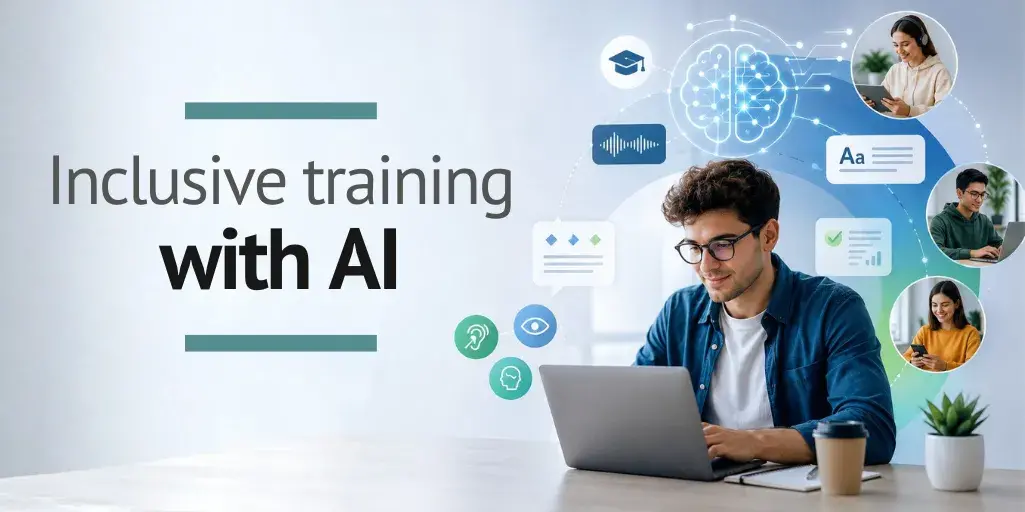
It is estimated that approximately 20% of the world’s population is neurodivergent, including people with ADHD, dyslexia, autism, dyspraxia and other forms of different cognitive processing.
When we apply this to the workplace, it means that one in five people in a company’s workforce may learn, process information and solve problems in a non-standardised way. In many cases, this creates critical knowledge gaps within the company itself.
Much of traditional corporate training is still based on rigid learning pathways and often ignores this reality. Whether in onboarding processes, compulsory compliance courses or professional development programmes, it is common to find long content, inflexible formats and identical learning speeds for every employee. The problem is that what works for one person may become a learning barrier for another. However, AI can transform this scenario through adaptive learning, making inclusive corporate training much more achievable.
Many companies have tried to introduce inclusive measures through adaptations such as extending exam times or providing supplementary materials, but these static solutions are not always 100% effective.
This is precisely where artificial intelligence is beginning to make a real difference, allowing e-learning platforms to automatically adjust the training experience according to each learner’s needs, which is especially useful for neurodivergent people.
According to some reports and studies, AI in training has helped reduce errors linked to impulsivity in people with ADHD by 32.1%, improve reading speed in people with dyslexia by up to 13%, increase completion rates by between 23% and 35%, and boost engagement by up to 68%.
The invisible 20%: why traditional corporate and academic training fails
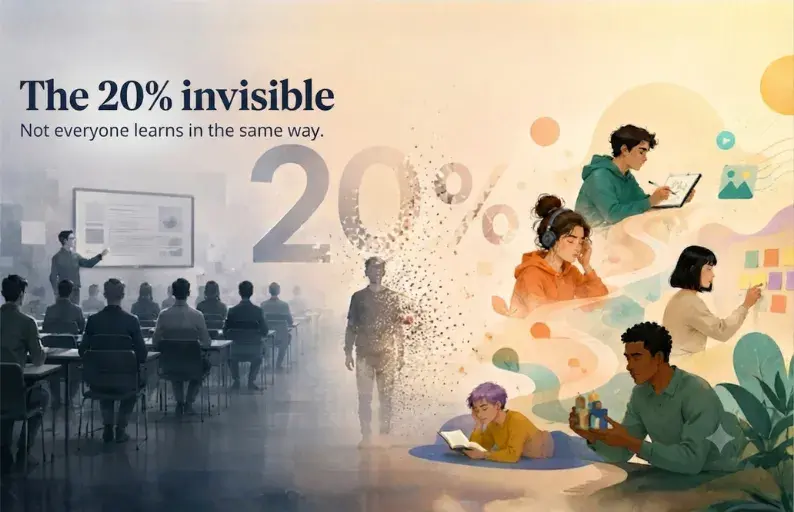
Although technology has transformed the way we learn, many training experiences still operate according to the same old logic: one type of content, one pace and one assessment method for every learner or employee.
The problem is that reality is far more diverse. Around 20% of the population is neurodivergent, which means that a significant number of learners and workers process information, maintain attention or absorb new knowledge differently. However, most training programmes are still designed with just one profile in mind, which clashes directly with the main eLearning trends now demanding personalised environments and inclusive teaching.
For example, in an academy or university, a learner with dyslexia may encounter very long blocks of text that make content harder to understand, while a person with ADHD may struggle to maintain concentration if courses are not highly interactive.
The same applies in the workplace. During an onboarding process, a new employee receives hours of training, documentation, videos and a large amount of information that they need to absorb in a short space of time. For many workers, this is already a challenge in itself, but for a neurodiverse person, it can become even more frustrating.
That is why the real obstacle does not lie in each person’s ability to learn, but in how training is designed. When content can only be consumed in one way and there is only one method of assessment, part of that talent is left behind.
As already discussed at the Líderes por la Inclusión event, organised by Eurofirms Foundation, in Spain only 1 in 4 neurodivergent people of working age is in employment, limiting both talent within companies and retention in academies.
AI for neurodiversity in corporate and academic training: from adaptation to optimisation

For many years, inclusion in training has been based on making specific adaptations for those who needed them, such as more time to complete an assessment, supplementary materials or changes to the content format.
Although these adjustments have represented progress and provided important support, they still start from the limited idea of creating a standard course and making changes only when they are needed.
Artificial intelligence offers a completely different approach. Instead of modifying training after a problem has been detected, adaptive learning platforms make it possible to optimise and personalise the learning experience from the outset, adapting content, activities and assessments to each person’s needs.
In addition, AI can analyse training by detecting behaviour patterns, identifying obstacles before they appear and monitoring each learner 24/7.
The goal is no longer for every learner or employee to adapt to the course, but for the course to adapt to them through more advanced measures such as dynamic content creation, flexible assessments, immediate feedback and personalised learning paths.
Tailor-made dynamic content
One of the greatest advances of AI applied to training is its ability to adapt online courses and the way information is presented.
For example, an e-learning platform can automatically adjust the design and visual layout to make reading easier for people with dyslexia, such as changing the font size or prioritising formats such as audio, video or interactive content.
AI also makes it possible to apply techniques such as chunking or content fragmentation. Instead of presenting excessively long modules, information is divided into smaller sections that are easier to process and retain, following the same principles of microlearning and nano-learning.
The result is an accessible LMS and a less overwhelming experience that is much more closely aligned with the way each person learns.
| We recommend that you... | |
|---|---|
| If your workforce or learners include profiles with dyslexia, focus on visual content and dynamic typography. |
Tailor-made dynamic content
When we think about assessments, questionnaires, multiple-choice exams or written tests often come to mind. However, demonstrating knowledge and understanding a concept does not always mean doing so in the same way.
With the help of artificial intelligence, e-learning platforms can offer multiple adapted assessment formats based on each user’s preferences and abilities. A learner might respond by voice instead of text, present an explanation in audiovisual format or complete a practical activity that demonstrates knowledge acquisition. In this context, Adaptive learning platforms allow Adaptive learning to become more flexible and better aligned with each person’s real needs.
This makes it possible to assess whether the person has genuinely understood the content and knows how to apply it, regardless of the assessment format used. AI-driven adaptive learning platforms help strengthen Inclusive training and make Adaptive learning AI more effective.
In the corporate environment, these alternatives are highly useful in onboarding programmes, technical training or internal certifications, where the goal is to validate real skills and not simply pass a final exam.
| We recommend that you... | |
|---|---|
| If your workforce or learners include autistic profiles or people with dysgraphia, focus on flexible, multi-format assessments. |
Immediate feedback to avoid frustration
One of the main causes of demotivation in online training is the feeling of being stuck without receiving help at the right moment.
Virtual assistants are changing this by providing 24/7 support throughout the training journey. These tutors use the Socratic method, guiding the learner step by step through questions, clues and explanations until they find the solution on their own. In this sense, Adaptive learning platforms can make Adaptive learning far more responsive to each person’s real needs.
Virtual tutors also make it possible to answer questions instantly, give feedback immediately on an activity and provide continuous motivation and support. As they are available at any time, waiting times are reduced and the experience becomes much more personalised, especially when they are integrated into Adaptive learning in machine learning systems and supported by the Best AI for special educational needs.
| We recommend that you... | |
|---|---|
| If your workforce or learners include profiles with ADHD or autistic profiles, focus on flexible, multi-format assessments. |
Personalised learning rhythms
Not everyone learns at the same pace. While some learners or employees can quickly absorb new concepts, others need more time or more practice before moving on to the next level.
When training follows the same rhythm for everyone, some people feel overwhelmed by the amount of information they receive in a short period of time, while others lose interest because the content moves too slowly for them.
Artificial intelligence makes it possible to overcome this through systems capable of adapting the training pathway individually and personally. By analysing factors such as the time spent on each activity, assessment results or interaction patterns with the content, Adaptive learning platforms can identify when a user needs additional support and when they are ready to move forward.
For example, if an employee struggles to understand an internal procedure, Adaptive learning in machine learning can recommend additional content, propose reinforcement exercises or present the information in another format. On the other hand, if they quickly master a topic, they can move forward without having to complete unnecessary modules.
Greater accessibility in employee training makes courses more efficient for everyone, reducing frustration and increasing motivation. It also reinforces the Importance of accessibility in employee training as a key part of long-term Inclusive training.
| We recommend that you... | |
|---|---|
| If your workforce or learners include profiles with ADHD, dyslexia or dyspraxia, focus on offering personalised learning rhythms. |
Better inclusion and more real benefits for your business

When we talk about inclusive e-learning training, it is not just about meeting accessibility requirements in an LMS. It means designing learning experiences that adapt to different cognitive profiles, something that also has a direct impact on business results, both for companies and academies.
For years, it has been accepted as normal that some learners drop out of courses or that certain employees need more time to complete a training programme. But when training adapts to people, these problems are reduced almost entirely.
Several studies on adaptive learning AI show improvements in learner participation, higher completion rates and a reduction in the time spent on training.
- A 25-35% increase in course completion rates and reduced drop-out.
- Greater learner satisfaction.
- Increase in renewals and recurring enrolments, leading to higher revenue.
- Better reputation and more recommendations.
- Ability to train a more diverse audience without having to create multiple independent pathways.
- Differentiation from other academies that still offer standardised training experiences.
- Faster and more effective onboarding processes.
- Up to 50% less time spent on training by removing unnecessary content and personalising pathways.
- Reduced frustration associated with internal training.
- 68% improvement in engagement and participation.
- Greater neurodiversity in the company.
- Improved Retention of neurodiverse talent by offering experiences that are better adapted to individual needs.
| AI impact metric | ROI for academies and training centres | ROI for companies |
|---|---|---|
| 68% improvement in engagement | More participative learners who complete the courses and recommend the platform. | Drastic reduction in drop-out rates in compulsory prevention or process-based courses. |
| 25-35% increase in completion rates | Increase in recurring revenue through renewed enrolments and certifications. | Reduced legal risk in compliance audits or onboarding plans. |
| 50% reduction in study time | Ability to train more learners with the same resources, optimising costs. | Acceleration of Time-to-Proficiency: the employee becomes productive in half the time. |
| 30% increase in knowledge retention | Greater prestige for the academic brand in the market. | Real preservation of know-how and corporate cognitive diversity. |
| 62% improvement in assessment results | Greater mastery of content thanks to Adaptive learning. | More effective acquisition of skills that can be applied to the role. |
Inclusive corporate training does not only benefit neurodivergent employees and learners; it also helps companies develop their teams more effectively and unlock the potential of people who, in some cases, have been left out of traditional learning models.
Cognitive diversity is a reality and, as companies and academies become more diverse, traditional models based on static content and identical experiences for everyone will become increasingly limited and obsolete. This is particularly relevant for neurodivergent companies that want to move beyond one-size-fits-all training.
Preparing your LMS for Adaptive learning AI is no longer a matter of innovation or e-learning trends, but of competitiveness and inclusion. Organisations that invest in AI-driven adaptive learning platforms capable of personalising content, rhythms, assessments and learner support will be better prepared to train, develop and retain talent in an increasingly diverse environment. With the right LMS accessibility tools, an Accessible LMS, Accessible LMS training and Adapting online learning become central to Inclusive corporate training online and Inclusive corporate training for employees.
Frequently asked questions
What is Inclusive training?
Inclusive training is an approach designed to ensure that anyone can learn on equal terms, regardless of how they process information. In e-learning, it means designing content that is more flexible, accessible and adaptable to different learning rhythms and styles, rather than relying on one standard pathway.
What is Adaptive learning AI?
Adaptive learning AI is a form of training that adjusts dynamically to each user in real time. The e-learning platform system analyses variables such as time spent on a task or error patterns to adjust formats, difficulty levels and rhythms individually, depending on how each learner progresses. It is also closely linked to Adaptive learning in machine learning and the development of neurodivergent companies that need more flexible training models.
How does AI help learners with ADHD?
AI helps to divide content into smaller parts, avoid long blocks and adjust the learning pace. It can also offer reminders and more interactive formats, helping learners maintain attention and reduce the feeling of overload during training.
Can AI improve the learning experience for people with dyslexia?
Yes. It can change the font type, improve contrast, offer audio as an alternative to text or simplify the way information is presented. All of this makes it easier to read and understand content.
Does adaptive training only benefit neurodiverse people?
No. Although it is extremely useful for neurodiverse profiles, it also improves the experience of any learner. Each person has their own learning style, so personalised learning in e-learning makes training clearer and more effective for everyone.