In many organisations, there’s a constant feeling that something is missing in employees’ knowledge. Processes that aren’t followed as they should be, projects that take longer than expected, or a sales team that isn’t closing as many deals as anticipated. The problem is that, even though companies can sense these gaps, few actually know which skills are missing or who needs support.
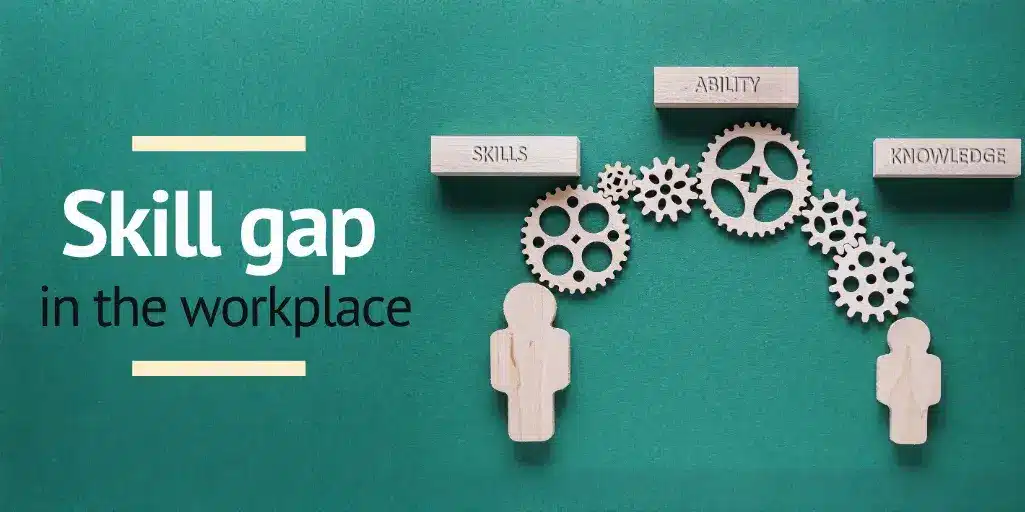
That’s where the skill gap comes into play — a concept that highlights the difference between the skills your workforce currently has and those they need to perform at their best.
With an e-learning platform like evolCampus, training is no longer a shot in the dark. Thanks to its assessments and reporting tools, you can quickly see who knows what — and, more importantly, what each team member is lacking.
In this way, identifying the skill gap allows you to stop investing in random courses and start making strategic decisions. For example, if a report shows that 40% of your sales team struggles with closing deals, you know exactly where to focus your efforts.
The risk of blind training is an opportunity cost

Nowadays, creating and delivering courses without a clear strategy behind them can become one of the most significant financial mistakes for many organisations. Investing in training without truly understanding which skills are missing not only wastes budget, but also squanders time and resources that could have been allocated to areas where the employees’ skill gap is real.
The issue is not just that employees may lack certain training, but that the organisation doesn’t actually know what its teams don’t know. In this sense, an LMS should evolve from being a simple content repository into a performance insight tool capable of identifying gaps.
Our e-learning platform evolCampus, through its reports and dashboards, enables you to move from perceived needs to data-driven evidence, identifying in just a few minutes not only who has completed a course, but also which skills they have mastered and where there are specific learning barriers.
This learning analytics allows you to make more informed decisions and ensures that your training investment is directed towards areas that truly impact business performance and productivity.
Methodology to identify skills gaps
How to identify skills gaps? Detecting them is easier than it seems. It’s not about conducting surveys or interviews with your team, but rather about using your LMS with a practical approach and extracting insights that help you identify the skill gap.
To do this, you should:
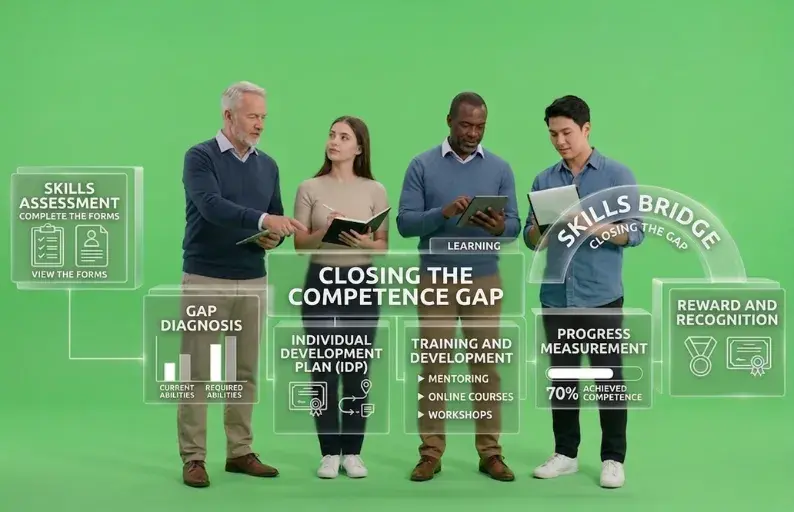
- 1. Define operational KPIs: before assessing skills, it’s essential to clearly outline your business objectives and what you aim to improve through training. For example, increasing sales of a specific product, reducing customer support response times, or ensuring compliance with regulations.
- 2. Map critical competencies: once your objectives are defined, you need to identify which skills support those KPIs. For instance, to improve sales closures, your sales team must master negotiation and closing techniques. This mapping allows you to focus on what truly matters, avoiding generic or unnecessary training.
- 3. Conduct a diagnostic assessment: once KPIs and critical competencies are clear, the next step is to verify what employees actually know about the topic. With e-learning platforms like evolCampus, you can design quizzes, tests and exercises that measure specific skills and detect where gaps exist. This is where skills assessment becomes essential to gain accurate insights.
- 4. Analyse skills gaps and generate reports: once assessments are completed, review the data and reports generated by your LMS to identify patterns and shortcomings. This step is key to performing a proper skills gap analysis, allowing you to clearly visualise which areas require reinforcement.
- 5. Design personalised action plans: based on this diagnosis, create tailored training pathways for each identified gap. This is where employee skills assessments help ensure that each learner receives exactly the training they need, optimising time, resources and overall impact.
- 6. Analyse impact: once training has been adjusted, it’s important to evaluate whether the gaps have actually been closed. Review results, improvements in KPIs, and whether there has been practical application in the workplace. This continuous evaluation is a key part of how to do a skill gap analysis effectively over time.
Level assessment quizzes as a skills thermometer
Quizzes act as a skills thermometer. In evolCampus, it is possible to configure evaluation methods within the LMS, such as pre-assessment quizzes, so employees don’t feel they are wasting time on what they already know — ultimately increasing satisfaction and knowledge retention.
These quizzes go beyond simply pass or fail, categorising mistakes by topic areas and showing exactly which competencies need reinforcement. This makes it easier to fine-tune training and ensure that each module is designed to address a real need, supported by effective skills assessment processes.
From diagnosis to budget efficiency: the ROI of an LMS

Once skills gaps have been identified and training materials and modules have been refocused, training shifts from being just another expense to becoming a profitable investment.
In terms of ROI, moving from delivering training without a clear purpose to implementing a strategy-driven approach can make a significant difference — particularly when measuring the ROI of B2B training.
For example, imagine a company investing in 100 hours of generic training for its IT team. This involves:
- Employees spending more time away from their roles while completing the training.
- Covering content that, in many cases, they already master.
- As it is generic training, it has a very low real impact on day-to-day operations and business outcomes.
- A low ROI from the training investment.
- Training time — and therefore productive working hours — is reduced by 80%.
- There is a greater real-world application in the workplace, as the content addresses a specific, practical need.
When translated into numbers, even as an estimate, the impact on budget and investment is significant.
Let’s assume a team of 20 people, with an average training cost of €30 per hour per employee:
- Generic training: 100 h × €30 × 20 employees = €60,000
- Targeted, diagnosis-based training: 20 h × €30 × 20 employees = €12,000
The skill gap in regulated sectors: beyond productivity, compliance
In regulated sectors such as healthcare, safety or legal services, identifying the skill gap is not only key to improving productivity and team knowledge — it is also essential to ensure compliance with current regulations and avoid potential penalties or fines.
In these environments, training is not optional or recommended — it is mandatory. Many organisations roll out courses, track attendance, and assume that everyone has acquired the necessary knowledge. However, in the face of an audit, this is not enough if employees have simply completed the course without demonstrating real understanding.
A well-implemented LMS ensures not only that training has been completed, but also that 100% of the workforce meets the required competencies before an audit takes place.
This is achieved through mandatory assessments on specific regulations, personalised tracking of each employee’s level, and alerts and reports that identify who has not yet met the required standards. This is where employee skills assessments play a crucial role in validating actual competence.
As a result, organisations gain full visibility and control, knowing exactly who is prepared and who requires further development before an inspection.
For example, a company in the healthcare sector must ensure that all staff comply with hygiene and safety protocols. Without a diagnostic system, they may launch a general course and record a 100% completion rate — but without real certainty regarding the level of understanding.
By contrast, with a data-driven approach based on evaluation and skills gap analysis, it is possible to detect, for instance, that 25% of the team fails in “Sterilisation protocols”. This allows the organisation to focus only on that specific area with targeted training. As a result, before an audit, you can demonstrate not only that training has been delivered, but that the required level has been achieved.
In this way, beyond reducing the risk of penalties, organisations also improve day-to-day operational safety with a more capable and prepared workforce.
Companies using e-learning to identify skills gaps and achieve results
Many organisations have embraced data-driven training through e-learning platforms to identify skill gaps and design targeted learning pathways.
For example, the Santander UK case study shows how the company needed to strengthen its capabilities in tackling financial crime, addressing threats such as money laundering, bribery and tax evasion.
The main challenge was understanding exactly what each employee and department knew, and where knowledge gaps existed in order to prioritise training. To achieve this, a workforce skills assessment was carried out to map requirements and identify gaps, supported by a structured skills gap analysis.
This is how the bank created the Anti-Financial Crime Academy (AFCA), an e-learning environment that centralises all training related to financial crime and prioritises specific areas instead of offering generic content. As a result, 83% of participants reported gaining new knowledge and skills.
Identifying the skill gap is not just about training — it is a strategy to save resources, increase productivity and reduce risks within organisations. With an LMS like evolCampus, you can access the data needed to measure results, detect gaps and prioritise both training and investment. This approach also supports how to identify skills gaps and even how to identify knowledge gaps in a structured and scalable way.
FAQs about the skill gap

What is the difference between skill gap and skill mapping?
How often should a skills diagnosis be carried out in an LMS?
Which indicators help identify a skill gap within a company?
What tools help identify skills gaps?
How should you prioritise which skills to train first?
Which skills tend to become outdated most frequently?
The most commonly outdated skills are typically technical ones, related to new tools or software, as well as those linked to legal areas that are constantly reviewed and updated. Regular employee skills assessments help keep these areas under control and up to date.