An AI assistant integrated into the course content answers questions about the material 24/7 and makes the content easier to understand, but it does not replace the tutor, provide technical support for the LMS or mark exams on its own.
This is one of the most common questions companies and training providers ask when looking for an LMS with artificial intelligence. Many organisations attend a demo expecting AI to be able to answer any question, handle technical issues, mark assessments automatically or even replace the tutor.
However, the reality is slightly different: AI in online training does not remove the need for a tutor, but instead redistributes tasks between artificial intelligence and people, making courses more efficient and improving their quality.
So, which tasks does an AI assistant integrated into the content actually take on? We explain what artificial intelligence in e-learning can resolve and when the involvement of a human tutor remains essential.
Can AI in online training replace the tutor?

No, AI does not replace a course tutor, but it does take on many of their tasks, allowing tutor support to become more personalised, responsive and effective.
An AI assistant handles and answers repetitive questions related to understanding the course material, while the human tutor focuses on tasks that require greater judgement, experience and direct support.
AI removes some of the most time-consuming routine tasks, not tutors or trainers. Learners receive immediate feedback outside tutoring hours, while trainers no longer have to answer the same questions time and again.
At evolMind, we have developed Evolina, an AI assistant integrated into the course content to support learners.
With Evolina, tutors can:
| Without AI | With an AI assistant such as Evolina + a human tutor |
|---|---|
| Repeatedly answering the same questions about the course content. | Evolina answers all questions related to understanding the course material, including the most frequently asked ones that take up a significant amount of the team’s time. The tutor can always step in when a concept has not been understood or requires a more in-depth explanation. |
| Spending time explaining the same basic concepts over and over again. | The tutor explores more complex concepts and practical aspects in greater depth, adapting their explanations to each learner’s needs. |
| Answering questions only during certain hours. | Evolina responds 24/7, while the tutor steps in when their input adds value. |
| Spending a large proportion of their time on repetitive tasks. | The tutor can devote more time to monitoring progress, motivating and supporting the learner. |
| Creating content in different formats, such as outlines, articles or summaries. | At the learners’ request, Evolina condenses and summarises complex content to make it easier to understand. |
What can an AI assistant help with?
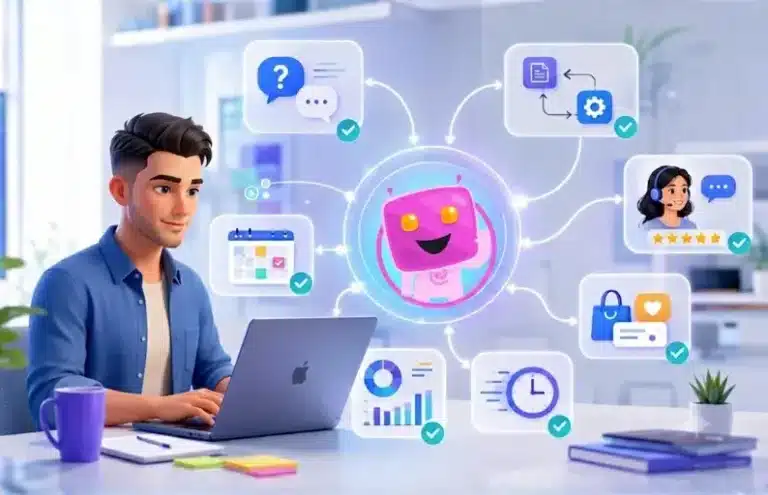
An AI assistant such as Evolina in evolCampus answers questions about the course content to help learners understand the material better at any time, without having to wait for the tutor. They can simply ask a question or give an instruction, and the assistant will respond.
This AI assistant is embedded in the course content, so its answers are generated using the training materials available within the course. This ensures that responses remain contextualised and linked to content that has been validated by the organisation.
As a virtual assistant for e-learning, Evolina can answer any question about the content, summarise complex PDF articles, simplify the language used in technical texts, provide specific examples, create outlines of videos or connect concepts across different modules without the tutor having to step in.
Use cases for a virtual assistant for e-learning such as Evolina
To understand Evolina’s role more clearly, here are some examples of questions a learner might ask during a course:
- When faced with a dense 20-page PDF: “Summarise it for me using the five key ideas” or “What are the most important points in this document?”. This gives them an overview before they explore the material in greater depth.
- When they come across highly technical or complex content: “Explain section 3 in simpler terms” or “Explain it as though I were studying this topic for the first time”. Evolina adapts the explanation to make it easier to understand without changing the content.
- When a concept appears again in different modules or subject areas: “How is topic A related to topic B?” or “Why does this concept appear again in this section?”. This helps learners connect different areas of knowledge and understand the course structure more clearly.
- When they need to put theory into practice: “Give me an example of how this concept is applied” or “Give me a practical example related to this process”. Examples make information easier to interpret and help reinforce key concepts.
- When they have a specific question while studying: “What is the difference between these two concepts?”, “What does this term mean?” or “Where is this explained?”. They receive an immediate answer without having to search through previous modules or wait for the tutor to respond.
What learners—and training providers—gain
Using an LMS with artificial intelligence improves the overall learning experience for learners, trainers, training providers and companies alike.
- Greater independence when studying outside online tutoring hours.
- Immediate answers to questions about the course material.
- Fewer interruptions caused by difficulties understanding the content, as they can request explanations, summaries and examples whenever they need them.
- A smoother learning experience that does not disrupt their pace of study.
- Fewer repetitive questions for the training team.
- More time for tutors to monitor each learner’s progress and provide tailored training support.
- Support for learners available 24 hours a day for questions related to the course content.
- A more efficient division of tasks between AI and the human tutor. This improves the scalability of training and makes better use of the training team’s time.
What does Evolina not handle within evolCampus?
Evolina is not designed to manage every aspect of the e-learning platform with AI. Its main role is to support learners, not to replace every LMS task and setting.
It does not provide technical support for the LMS. If a learner cannot access the platform, has forgotten their password, encounters an error when viewing content or experiences any other technical issue related to the LMS, they should contact the support team rather than the AI assistant.
The same applies to information that is unrelated to the course: AI does not answer questions about a company’s internal processes. In corporate internal training, learners often ask about annual leave, procedures or other matters relating to the organisation.
For example: “How many days of annual leave am I entitled to?” or “How do I carry out this procedure?”. Evolina cannot answer questions about internal company processes unless that information is included in the course. It can only use the materials available within the course.
It does not mark exams independently either. Although it can help learners prepare for an assessment by explaining concepts or answering questions about the course material, it does not decide whether an answer is correct or replace the assessment process. Exam marking also depends on the type of activity and the criteria established for each course.
Likewise, it does not replace the tutor’s judgement, as many situations require an understanding of context, a human perspective and the kind of closer support that only another person can provide.
A generic chatbot vs an assistant integrated into the course

Not all artificial intelligence tools provide the same learning experience or answer learners’ questions in the same way. Although they may seem similar, a generic chatbot and an AI tutor integrated into the course perform very different functions.
A more generic online training chatbot will usually provide predefined answers to basic questions and have a more limited scope. Other LLMs, such as ChatGPT, generate responses based on the knowledge they were trained on and the instructions they receive.
These chatbots can be useful for answering general questions or explaining concepts, but they do not have direct knowledge of a course’s specific content or the learning pathway designed by the organisation.
An assistant such as Evolina works directly with the materials stored in the LMS, including PDFs, videos and course texts. Its purpose is not to answer every possible question, but to help learners understand the content they are studying at that moment by providing relevant context and showing the connections between concepts.
Furthermore, because the artificial intelligence is integrated into the company’s own e-learning platform with AI, there is no risk of the organisation’s private data or confidential information being leaked: everything remains within the LMS.
When should the human tutor step in?
Questions an AI assistant such as Evolina filters out so the tutor does not have to answer them repeatedly
Before they reach the tutor, many questions can be answered automatically using the virtual assistant for e-learning, including:
- Repetitive questions about the course material.
- Explanations of complex or overly technical concepts.
- Summaries of lengthy documents, videos or other materials.
- Practical examples to help learners understand a concept more clearly.
- Differences between related terms or content.
- Connections between concepts covered in different parts of the course.
- Specific questions about the information included in the training materials.
Situations that require human judgement
There are times when an automated response is not enough. A learner may understand the content but still struggle to make progress, organise their workload or stay motivated.
In these situations, human involvement remains essential:
- Supporting learners who are experiencing greater difficulties: a learner who is progressing more slowly than expected may need guidance to reorganise their workload and pace.
- Motivating learners and keeping them engaged with the course: online training requires independence, but also ongoing support and encouragement when learners encounter difficulties.
- Understanding specific circumstances: falling behind on a course may be caused by a lack of time, difficulties with the content or personal circumstances that require a fuller understanding of the context.
- Providing personalised support: every learner has a different pace and different needs, particularly in corporate programmes where employees from different departments are required to complete the same training.
Who handles what?
Each tool within the evolCampus LMS has a specific role:
- Evolina is an AI assistant that acts as a virtual LMS tutor, helping learners understand the course materials more clearly.
- The tutor provides human support and guidance, stepping in when professional judgement or a more personal approach is required.
| Learner / training provider requirement | Evolina | Human tutor |
|---|---|---|
| Understanding a concept covered in a PDF | ✓ Explains, simplifies and contextualises the course content. | X |
| Summarising a video | ✓ Summarises the key points of the training material. | X |
| Being unable to access the platform | X | ✓ Directs the learner to the support team or handles the issue. |
| When will the exam take place? (internal process) | X | ✓ Responds according to how the course has been organised. |
| Marking my assignment and awarding the final grade | X | ✓ Assesses the assignment according to the established criteria. |
| A learner who has not accessed the platform for 10 days | X | ✓ Decides on the most appropriate action and communication. |
| Motivation issues | X | ✓ Supports, listens to and guides the learner. |
| Creating the course structure and script | X evolCampus AI transforms your content into more dynamic and engaging resources for learners. | ✓ The course structure and script are created by the human team using their expertise and/or prompts with AI support . |
Frequently asked questions about artificial intelligence in e-learning

Can AI in online training replace the tutor?
Can an AI assistant within an LMS answer questions about any topic?
Does AI mark exams automatically?
How is it different from giving learners access to ChatGPT?
How does this help a training provider or HR team?
What should I ask during a demo of an LMS with artificial intelligence?
Before choosing an LMS with artificial intelligence for your company or training provider, you should ask:
- What tasks does the AI perform, and what does it not do?
- How does AI help tutors and trainers monitor learners’ progress?
- How does AI support learners throughout the course?
- What data can AI provide about learner behaviour?
- Is it a general-purpose chatbot or an AI assistant integrated into the course content?