
Online training in physiotherapy is not about recording classes; it is about providing structured learning pathways, maintaining a clear audit trail and issuing certificates without greatly increasing the time spent on coordination. For a training academy or a professional body, this means organising programmes that may include several modules, assessments, progression requirements and completion criteria, and being able to demonstrate afterwards what each professional has completed.
The challenge grows when you manage multiple specialisms and course intakes at the same time, or combine online training with practical sessions. Learners are also usually practising physiotherapists who need to fit professional development around consultations, patient care and clinic hours. Flexibility for learners must not mean extra monitoring work for the team organising the training.
This is where a virtual campus for physiotherapy comes in: it allows you to structure the part of the training that can be completed online, track each learner’s progress and centralise the evidence needed to assess and certify their participation. Clinical practice will still need to take place in person where appropriate; what you can avoid is managing the rest of the process through emails, spreadsheets and learner-by-learner checks.
If you manage continuing professional development at a physiotherapy academy or professional body, request an evolCampus demo.
Which parts of physiotherapy training are suited to online delivery?
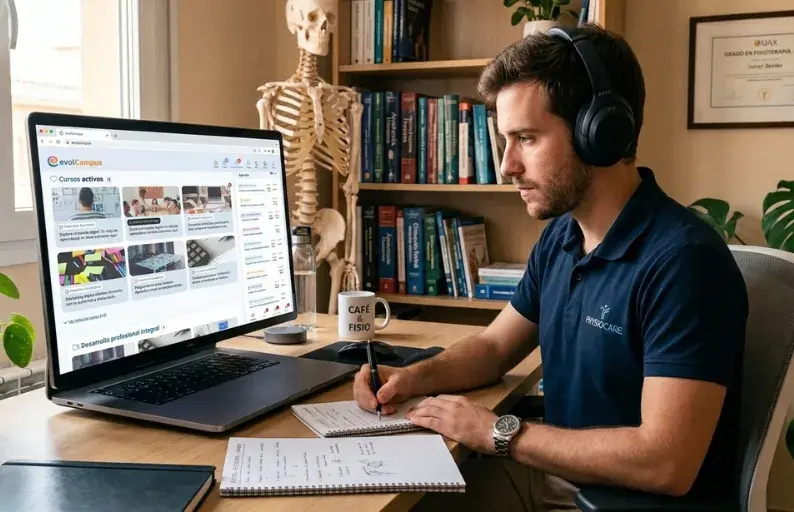
Online training in physiotherapy is particularly well suited to keeping knowledge up to date, covering theory and completing certain assessments; techniques that require hands-on practice, physical interaction or direct supervision call for a different approach.
For a physiotherapy academy, the question should not be whether to deliver training online or in person, but what the professional needs to learn and demonstrate at each stage of the programme.
Examples from the profession itself illustrate this variety. Professional bodies organise training in areas such as therapeutic exercise, pharmacology, oncology physiotherapy, neurology and research, using different delivery formats according to the objectives of each activity. Some programmes are delivered entirely online, with physiotherapists required to complete a sequence of modules and assessments, while courses with a predominantly practical focus retain face-to-face delivery.
This distinction allows for different training models:
- Online theory and refresher training, where the aim is to acquire or update knowledge through independent learning.
- Sequential programmes, where certain modules or assessments must be completed before moving on.
- Blended training, where theory can be covered online but certain skills need to be developed in person afterwards.
- In-person practical sessions, where learning depends on performing a technique, observing it being carried out or receiving direct feedback and corrections.
For those organising the training, this combination of online and face-to-face physiotherapy training requires more than just hosting content. If a learner must complete a theoretical component before progressing to another stage, you need to know whether they have actually completed it and met the requirements. If several course intakes or specialisms are running at the same time, you also need to keep track of which pathway each participant should follow.
That is why the value of online training in physiotherapy is not simply about making videos or documents available remotely. It lies in turning that training into a structured pathway, with clear progression and completion requirements, so you can scale physiotherapy training online without losing control as learner numbers grow.
| Type of activity | Online? | Requirement |
|---|---|---|
| Theory / regulatory / protocol updates | Yes | Independent learning + assessment |
| Learning pathway with prerequisites | Yes (management) | Conditional progression |
| Techniques requiring practice / supervision | No (or blended) | In-person clinical practice |
| Certification / certificates | Online (evidence) | Audit trail of learner progress |
What makes continuing professional development in physiotherapy harder to manage as learner numbers grow?

The challenge arises when an academy or professional body starts to manage more learners, specialisms and course intakes and rounds of corrections with the same resources. Each new course can involve enrolments, different groups, completion requirements, progress tracking and certificates, all of which need to be coordinated without losing sight of each physiotherapist’s individual learning pathway.
With a small number of learners, some of this can be managed using spreadsheets, emails or manual checks. Problems arise when the course offering expands and several courses run at the same time. At that point, knowing who is enrolled is no longer enough: you need to track what each participant must complete, how far they have progressed and whether they meet the requirements for completing their training.
Multiple specialisms and course intakes mean more learning pathways to manage
An academy may offer training in different specialisms and run several intakes of the same course throughout the year. If it also combines online modules with in-person activities, each group may have different dates, content and requirements.
The challenge is to keep these pathways separate without duplicating all the administration for each intake. Learners enrolled on one intake should not receive communications intended for another, access content they are not yet supposed to see, or attend a practical session without having completed the specified prerequisites.
As your course catalogue grows and you scale physiotherapy training online, managing these differences manually increases the risk of errors and forces the team to spend more time checking each learner’s status.
Practising physiotherapists do not all progress at the same pace
Online continuing professional development for physiotherapists has to fit around consultations, patient care and clinic hours. Flexibility makes this possible, but it also makes it less likely that an entire group will progress at the same pace.
For the training team, this highlights an important difference between having data and being able to use it. Knowing that 80 people are enrolled tells you little if you have to review each individual record to find out who still has an activity to complete or has not yet started.
Progress tracking is useful when it helps you distinguish between learners who are progressing as expected and those who need intervention. This allows the team to target reminders and support at the learners who actually need them, rather than turning learner support into a series of manual checks.
Much of the administrative work comes at the end of a course intake
When a course ends, it is not enough simply to have made it available for a set period. The organisation needs to check which participants have met the specified criteria: content completed, activities submitted, assessments passed or any other requirement set out in the programme.
If this information is scattered, you have to piece together each learner’s progress before you can certify physiotherapists online for the training they have completed and issue their certificates. The more participants and course intakes there are, the longer these checks take.
An audit trail allows you to take a different approach: instead of gathering evidence at the end, information about each learner’s progress is recorded throughout the process. This means that closing a course intake no longer depends on manually checking what each participant has done.
Training records must remain accessible after the course ends
Administration does not necessarily end when the certificate is issued. An academy, association or professional body may later need to check which training a participant completed, when they completed it or what result they achieved.
Having a record of each learner’s training history means you do not have to rely on separately stored documents or searches through previous course intakes. It also makes it easier to handle certificate-related requests or check participation in activities that have already ended.
As the volume of training grows, keeping this information organised goes from being an administrative matter to an essential requirement for maintaining an audit trail across all training activities.
How does an LMS fit into the training workflow of a physiotherapy academy or professional body?
An LMS for physiotherapy schools provides a single environment for learning pathways, learners, assessments and evidence that may previously have been spread across different tools. Its role is not to replace practical training, but to organise and provide an audit trail for everything that can be managed digitally.
This is particularly important when several course intakes or delivery formats run alongside one another. A physiotherapy academy LMS can act as the central hub for each learning pathway: showing what each learner needs to complete, recording their progress and making certain stages of progression conditional on meeting the requirements set by the training provider.
Organise different learning pathways without starting from scratch for each group

Each specialism, level or course intake may need a different learning pathway. A virtual campus for physiotherapy allows you to structure these pathways and assign them to the relevant learners without manually duplicating all the administration for each group.
Consider, for example, a blended training programme with several theory modules, an assessment and a day of practical training. Using a physiotherapy school e-learning platform, the academy can specify which content each physiotherapist must complete before attending in person and check whether they have met those prerequisites.
If you later run a new course intake, you can keep the same programme structure while changing the participants, dates or specific content.
This means that running more course intakes does not necessarily involve rebuilding the process from scratch.
Identify who needs follow-up without checking every learner individually
Progress tracking becomes genuinely useful when it turns activity data into information the team can act on. Rather than reviewing every enrolled learner individually, the team can use an LMS for physiotherapy schools to identify who is progressing, who has outstanding tasks and where learners are getting stuck.
This also changes how you support professionals with demanding clinical schedules.
It is not about chasing learners every time they go a few days without logging in, but about spotting situations that need attention and focusing the team’s efforts where they are needed.
For example, if a course intake has 200 participants, the aim should not be to manually check 200 individual learning pathways every week. It should be to quickly identify learners who are going off track and take action.
| Task | Can be automated | Requires a coordinator or tutor |
|---|---|---|
| Sending reminders | ✔ | |
| Inactivity or drop-out alerts | ✔ | |
| Progress reports | ✔ | |
| Issuing certificates | ✔ | |
| Bulk enrolment | ✔ | |
| Answering complex questions about course content | ✔ | |
| Handling event-related issues | ✔ | |
| Reassignments or exceptional cases | ✔ | |
| Communicating with department leads | ✔ |
Link assessments and certificates to the training each learner has completed
When you certify physiotherapists online, issuing the certificate is only the final step. Before that, there must be a clear link between the criteria for successfully completing the training and the evidence showing that each participant has met them.
A physiotherapy academy LMS records the content, activities and assessments each learner completes as they progress, and links their certificate to those criteria. This means there is no need to piece together their training record at the end: the evidence is already recorded within the learning pathway.
Give physiotherapists flexibility without losing control of the course intake
Allowing each professional to progress at times that suit them does not mean giving up control over the training.
An LMS for physiotherapy schools can combine flexible access to content with deadlines, compulsory activities and common completion criteria.
This combination is particularly relevant to online continuing professional development for physiotherapists, where participants may have very different working hours and clinical workloads. Learners have more flexibility to fit their learning around clinical practice, while the organisation maintains a centralised view of activity across the course intake.
Flexibility no longer depends on the team handling exceptions through individual emails. The training requirements are defined from the outset, and the virtual campus for physiotherapy allows you to check that they are being met as each physiotherapist progresses.
What should an LMS for online training in physiotherapy offer?

An LMS for physiotherapy schools should make it easier to manage different programmes, learners and course intakes without adding extra layers of work for the team.
Rather than looking for the longest list of features, check whether a physiotherapy school e-learning platform supports the way your organisation actually works.
Here are seven requirements for a physiotherapy academy LMS that make a difference to day-to-day operations:
1. Separate management of groups and course intakes
2. Learning pathways with progression requirements
Making all the content available to learners from day one is not always enough. They may need to complete one module before accessing the next, pass an assessment or finish the theoretical component before attending a practical session.
The virtual campus for physiotherapy should allow you to build these requirements into the learning pathway itself, so that following the intended sequence does not depend on constant checks by the team.
3. Progress tracking for individual learners and the whole intake
How many learners have finished? Who still has activities to complete? Are there participants who have not started yet?
You should be able to answer these questions without reviewing records one by one. As well as showing an individual physiotherapist’s progress, a physiotherapy school e-learning platform should provide an overall view that helps you identify where delays or difficulties are concentrated within a group.
4. Assessments linked to completion criteria
A physiotherapy academy LMS should allow quizzes, activities and tests to be integrated into the learning pathway and linked to the requirements your organisation has set for successfully completing the training.
This means assessment is no longer a stand-alone element, but part of the learner’s audit trail: what they completed, the result they achieved and whether they met the specified requirements.
5. Certificates and diplomas linked to supporting evidence
To certify physiotherapists online for the training they have completed, you need more than automated PDF creation. The key requirement is that each certificate is backed by a record of the learner’s progress through the programme.
This helps reduce the checks needed at the end of each course intake and preserves an accessible training history should you need to verify a participant’s training later.
6. Straightforward access from different devices
Online training in physiotherapy allows practising professionals to work through theoretical content at times that suit them. An online physiotherapy CPD platform should therefore provide straightforward access from a computer, tablet or mobile, without adding technical difficulties to an already busy schedule.
Here, usability matters as much as flexibility: the more effort it takes to log in, find an activity or pick up where you left off, the harder it becomes to maintain continuity in learning.
7. Automation of tasks that recur with every intake
Enrolling participants, notifying them when courses open, sending reminders about key dates, tracking progress and issuing certificates are small tasks in isolation, but the workload quickly grows as learner numbers and course intakes increase.
A physiotherapy school e-learning platform should allow you to automate processes that follow defined rules, reserving the team’s input for issues, queries or decisions that genuinely need human attention.
It is usually clear when it is time to consider this change: if taking on more learners or launching new courses leads to a proportionate increase in the hours spent on enrolment, progress tracking, checks and issuing certificates, the bottleneck is not training delivery but the capacity to manage it. An LMS for physiotherapy schools should break that pattern.
For an academy or professional body looking to expand its course offering, choosing the right LMS means breaking that link: scaling up physiotherapy training without overloading staff or increasing the coordination workload at the same rate.
| Requirement | Signs it is missing | |
|---|---|---|
| 1 | Separate groups and course intakes | Course intakes or communications get mixed up |
| 2 | Learning pathways with prerequisites | Manual checks before practical sessions |
| 3 | Individual and overall progress tracking | Reviewing learner records one by one |
| 4 | Assessment linked to completion | Marks recorded in isolation, with no completion criteria |
| 5 | Certificate backed by evidence | PDF with no supporting training record |
| 6 | Access from multiple devices | Learners drop out because of technical difficulties |
| 7 | Automation for each course intake | Each course intake multiplies the time spent on administration |
Frequently asked questions about online training in physiotherapy

Can physiotherapy training be delivered entirely online?
How are certificates awarded for online physiotherapy training?
Can online training be combined with in-person practical sessions?
How can different specialisms and course intakes be managed within a single virtual campus?
When does a physiotherapy academy need an LMS?
Train more physiotherapists without multiplying the administrative workload
Expanding continuing professional development should not mean a matching increase in spreadsheets, emails and manual checks. An academy, association or professional body needs to know which training each physiotherapist should complete, how they are progressing and what they have completed, even when managing different specialisms and course intakes.
As an LMS for blended physiotherapy training, evolCampus lets you centralise these processes in a single environment: organising learning pathways, tracking progress, managing assessments and maintaining the audit trail needed for certification, while always respecting the role of in-person practice in physiotherapy training.
If every new physiotherapy course intake means more learners to enrol, more progress records to review and more certificates to manage, perhaps the next step is not to expand your team, but to review how you manage your training.
How much time does your team currently spend on tasks that could be handled within the virtual campus itself?