Many learning and HR leaders share a common concern: every new tool promises efficiency, but in practice it adds more administration, more processes and more checkpoints. Does that feeling sound familiar — that technology, rather than freeing up time, fragments it?
For years, the solution was to centralise everything in a single piece of software. However, as organisations have evolved, they have opted for an ecosystem of specialised tools — CRM, ERP, payroll software and training platforms — that work well individually but create a problem when they are not connected: disconnected data.
Today, the real challenge is no longer having more tools, but getting them to work as a coherent system in which different platforms interact intelligently with one another.
An Interconnected LMS stops being an isolated platform and becomes an active part of the digital learning ecosystem, capable of enabling LMS integration with the rest of your systems and supporting a continuous, useful training data flow. The question is no longer whether you need an LMS, but whether that LMS can work as a natural extension of your day-to-day operations.
Because when training flows automatically — when you can automatically sync data across systems, trigger processes without manual intervention and access information in real time — it creates a genuine shift in how the business learns, makes decisions and evolves.
In this context, understanding the value of a connected learning ecosystem is the difference between simply managing training and turning it into a true business driver.
Why the connected digital learning ecosystem is replacing “all-in-one software” in 2026
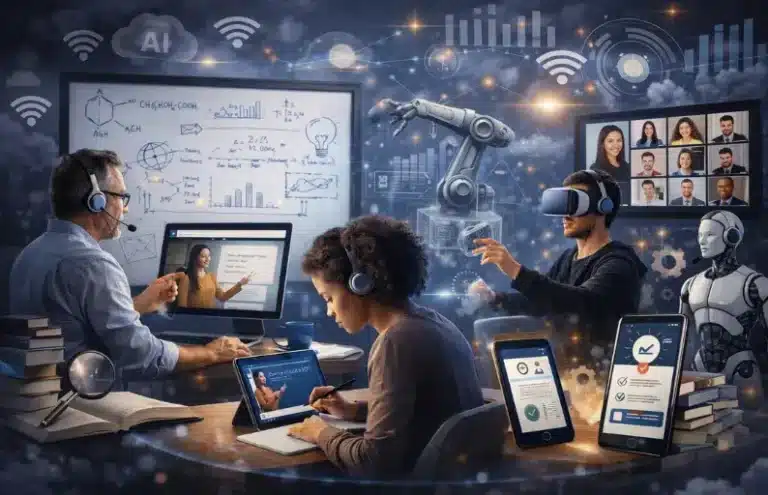
A digital learning ecosystem is replacing “all-in-one software” because it allows companies to work with specialist tools that communicate with one another, helping teams automatically sync information, avoid data fragmentation and build a truly efficient Connected learning ecosystem.
For years, many organisations invested in single solutions that promised to centralise all business management within one platform. On paper, it was an attractive strategy: one system, one supplier and one operating model. In practice, however, these tools often fell short in terms of specific functionality or evolved more slowly than the business required.
The result? Teams ended up adapting their processes to the tool, instead of the tool adapting to them.
In 2026, that logic has changed completely. The most competitive companies have adopted a best-of-breed approach: they choose the best CRM for sales, the best ERP for operations, the best payroll software for workforce management… and, of course, the best e-learning platform for developing talent.
This specialisation allows each key area of the business to gain greater depth, accuracy and adaptability.
The trade-off, however, is the need to find an effective way to integrate everything generated through these specialist tools. Without that, the risk is clear: the creation of information silos.
Indeed, this shift has brought with it a new challenge that many organisations are still learning to manage: the proliferation of tools creates information silos. Each system stores valuable data, but when that data is not connected, knowledge becomes fragmented. And when data is fragmented, decision-making becomes fragmented too.
This is where a figure appears that often goes unnoticed: the “human bridge”. These are the professionals who manually transfer information from one system to another. They export data, review it, upload it again into another platform, validate errors and correct inconsistencies. It is invisible, repetitive and costly work. Most importantly, it is a clear sign that the ecosystem has not been designed properly.
An Interconnected LMS breaks with this logic. It stops being an isolated tool or a standalone VLE and becomes an integrated layer within the company’s wider system. Rather than competing with the rest of the solutions, it strengthens them by supporting a coherent, continuous training data flow.
This also changes the way learning is perceived within the organisation. It is no longer a parallel process managed independently, but an integrated part of day-to-day operations. A new employee’s onboarding, their development in role, their certifications and their assessments… all of it becomes part of the same living system, where information flows without friction.
When a business uses several specialist tools, establishing strong LMS integration across them is a sine qua non. Otherwise, the organisation risks falling into a structural shortfall that prevents it from unlocking the full potential of tools that end up representing an inefficient investment of resources, time and money.
That is why talking about workplace learning today also means talking about technology architecture. And within that architecture, time-saving e-learning integrations make the difference between a system that works and a system that scales.
B2B training automation: how to automatically sync data across systems
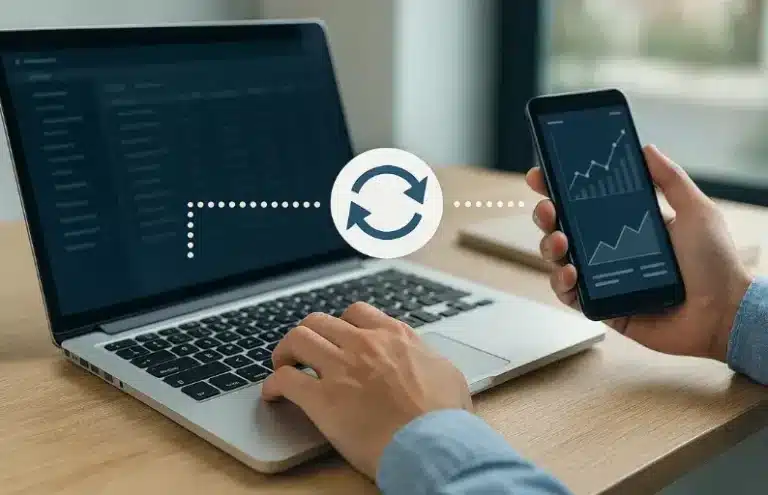
B2B training automation makes it possible to automatically synchronize data across systems, eliminating manual tasks, reducing errors and turning learning management into a smooth process within HR’s day-to-day work.
If, in the previous section, we talked about the importance of building a digital learning ecosystem, here we move on to one of its most tangible outcomes: time. Or, more specifically, how to win it back.
Because the real promise of automation lies not in the technology itself, but in what it frees up: hours of operational work that can be reinvested in strategic decision-making.
B2B training automation in practice: processes that run without manual intervention
B2B training automation takes shape through practical workflows that help automatically sync different systems, removing repetitive tasks at the most critical points in the employee lifecycle.
One of the clearest examples is, as we saw in the previous section, onboarding. When a new professional joins the organisation, their record in the HR system can immediately trigger their enrolment on the e-learning platform for internal training and the automatic assignment of learning pathways.
The same applies to an offboarding process, a particularly sensitive moment from a security perspective. When an employee leaves the company, their removal from the main system can automatically trigger the deactivation of access to learning content, avoiding risks linked to access to internal or strategic information. Here, automation stops being purely a matter of efficiency and becomes a guarantee of compliance.
Another relevant scenario is tracking learning in critical contexts. In sectors where training in safety, compliance or procedures is essential, an Interconnected LMS can detect risk patterns, such as repeated failed attempts in a key assessment, and trigger automatic alerts to supervisors or managers. This makes it possible to intervene in time, before the issue reaches the operational environment.
What is most valuable about these processes is that, once designed, they no longer depend on teams’ memory or workload and instead begin to operate consistently in the background.
What changes in HR when you can sync data across platforms
The ability to sync platforms transforms the role of HR, shifting it from managing operational tasks to leading strategic decisions within a Connected learning ecosystem.
When teams no longer have to spend time entering data, checking inconsistencies or coordinating manual processes, new space opens up for analysis and continuous improvement. The conversation stops revolving around “what still needs to be done” and starts focusing on “what can we optimise?”.
What is more, data quality improves significantly. By removing duplicate manual entries, the margin for error is reduced and teams can work with consistent information across every system. This has a direct impact on how much trust the organisation places in its own data, which is essential when that data is used to make decisions.
At this point, technology stops being a collection of isolated platforms and becomes an invisible infrastructure that supports how the business operates. HR API integration acts as the mechanism that makes this coordination possible, ensuring that each system contributes real value.
The result is a far more scalable operating model. The company can grow, bring in new people or expand its learning offer without this leading to a proportional increase in operational workload. And in an environment where agility makes all the difference, that ability to scale becomes a competitive advantage that is hard to replicate.
Interconnected LMS and training data flow: the true foundation of corporate AI
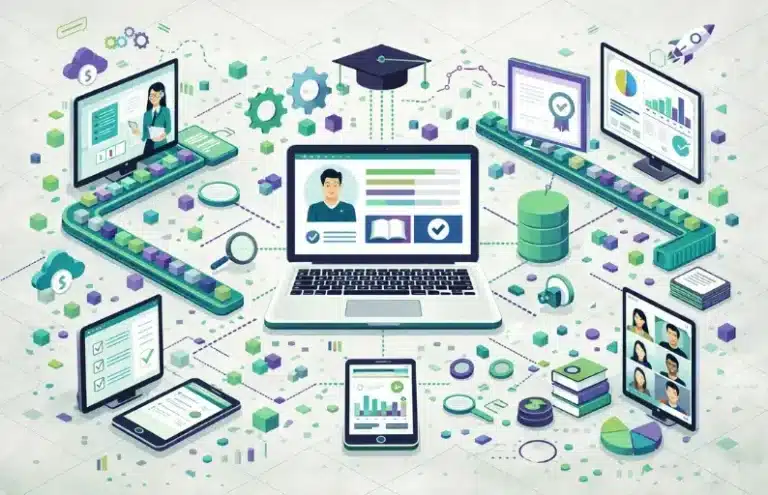
An Interconnected LMS or VLE makes it possible to generate a continuous, real-time training data flow, which becomes the essential foundation for corporate AI to deliver genuine value.
In recent years, artificial intelligence has gone from being a promise to becoming a priority for many organisations. However, there is one question that is rarely explored in enough depth: how good is the quality of the data feeding those systems?
Because AI does not work in a vacuum. It needs up-to-date, structured and connected data. And this is where many companies face their main limitation. They may have advanced analytics tools, predictive models or recommendation systems, but if learning data sits in disconnected platforms, standalone VLEs, static reports or files that do not automatically sync, their ability to generate value is reduced dramatically.
A well-designed digital learning ecosystem changes this scenario completely. When the LMS or VLE forms part of that connected system, every learner interaction — time spent, progress, assessment results and learning pathways — becomes live data that flows into the rest of the organisation.
This training data flow is not a historical record that is reviewed occasionally, but an active source of information that can be integrated into the corporate data lake.
This is where the conversation takes on a different dimension. It is no longer just about knowing who has completed a course, but about being able to combine information and identify meaningful patterns. Do the teams with the strongest sales performance show particular learning behaviours? Is there a relationship between time spent on training and fewer operational errors? Which learning pathways are creating a measurable impact on performance?
Without effective LMS integration, these questions remain unanswered or require complex manual analysis that does not scale well. With an Interconnected LMS or VLE, by contrast, the information is available in real time and can be combined with data from other areas of the business, from sales to productivity or retention.
With this shift, learning stops being an isolated function and becomes a strategic source of data. As a result, HR takes on a far more important role in business decision-making.
What is more, organisations can now do more than simply deliver training: they can analyse its impact, refine it and improve it continuously. AI can identify patterns, detect deviations and suggest improvements, but only if it has access to a constant, reliable flow of information supported by strong LMS integration and a connected VLE.
That is why talking about artificial intelligence in business without talking about systems integration only scratches the surface. The real issue is not simply having access to AI tools, but, above all, building the data infrastructure that makes them truly useful.
HR API integration: how APIs and webhooks make it possible to sync data in real time
HR API integration makes it possible to automatically synchronize data in real time through APIs and webhooks, ensuring that the training data flow remains active and up to date within the connected learning ecosystem.
To understand this point, it helps to simplify two concepts that are often seen as technical, even though they have a direct impact on day-to-day operations.
An API acts as a channel through which one system can request information from another. For example, an ERP can check an Interconnected LMS to view an employee’s learning status at a given moment.
A webhook, by contrast, works the other way round. Instead of waiting for another system to ask, the LMS itself sends a signal when a relevant event takes place. For example, when a user completes a course, has not logged in for several days or fails a critical assessment. In other words, it is a system that sends a real-time alert about what is happening.
This API + webhook combination in an e-learning platform makes it possible to build a dynamic architecture, where information does not remain static within the platform but moves constantly between systems. And that is precisely what allows organisations to automatically sync data without having to do it manually.
From an operational point of view, the result is a drastic reduction in update times. Data no longer depends on manual processes or periodic synchronisations to be available at the moment it is generated. This is especially important in environments where speed of response is critical.
What is more, this integration capability makes the system easier to scale. As the company brings in new tools or expands its technology infrastructure, the LMS can remain connected to the rest of the ecosystem without the need to redesign every process from scratch.
In this sense, having an e-learning platform that was designed from the outset to support LMS integration with other systems makes a significant difference. It is not about adding integrations as an extra feature, but about building a technology foundation that is ready to operate in complex, fast-changing environments.
Because, ultimately, the speed at which information flows through an organisation determines its ability to adapt. And in an environment where change is constant, businesses need real-time, up-to-date data.
Advantages of integrating LMS with CRM: the hidden ROI in data automation
The advantages of integrating LMS with CRM include a direct return in efficiency, better data quality and stronger decision-making thanks to automation and a training data flow that connects learning with business results.
At this stage, integration stops being a technical matter and becomes a clearly commercial decision with measurable impact. Even so, that impact is not always obvious at first glance, because many organisations still assess learning in isolation, without linking its effect to other key areas of the business.
LMS integration with a CRM breaks this disconnection. It makes it possible to connect learning with real performance indicators, such as sales, customer retention and productivity. And it is in that crossover that the real value appears.
Think about a sales team. Without integration, learning analysis and performance analysis sit in separate systems, which makes it difficult to establish clear relationships between them. By contrast, within a Connected learning ecosystem, where the Interconnected LMS or VLE is integrated with other business tools, it becomes possible to see how specific learning pathways affect concrete results. This type of insight makes it easier to refine strategies, prioritise content and make decisions based on evidence rather than intuition.
What is more, data automation significantly reduces operational costs. Every time an HR or learning professional has to move information manually from one system to another, they are spending time on a task that creates no direct value. At scale, that accumulated time becomes a structural cost that often goes unnoticed.
There is also another critical factor: human error. In regulated environments, or in sectors where learning has legal or safety implications, incorrect data can have serious consequences, from penalties to operational risk. By working with connected systems that allow teams to automatically sync data, organisations reduce that margin for error and improve data traceability.
That said, the ROI of this integration is not limited to time savings or fewer errors. It is also about speed of response. In business environments, decisions need to be made quickly, and that requires access to up-to-date information in real time. The company can detect deviations, identify opportunities and adjust its strategy more quickly.
In this context, the Interconnected LMS acts as a key part of the wider business architecture. It does not simply manage learning; it connects it with the rest of the company’s systems, allowing training to have a direct impact on business performance.
That is why, when assessing the advantages of integrating LMS with CRM, it is worth looking beyond the technology itself. What is really at stake is the organisation’s ability to align talent development with its strategic goals and build a system in which data flows coherently.
That said, the ROI of this integration is not limited to time savings or fewer errors. It is also about speed of response. In business environments, decisions need to be made quickly, and that requires access to up-to-date information in real time. The company can detect deviations, identify opportunities and adjust its strategy more quickly.
In this context, the Interconnected LMS acts as a key part of the wider business architecture. It does not simply manage learning; it connects it with the rest of the company’s systems, allowing training to have a direct impact on business performance.
That is why, when assessing the advantages of integrating LMS with CRM, it is worth looking beyond the technology itself. What is really at stake is the organisation’s ability to align talent development with its strategic goals and build a system in which data flows coherently.
Frequently asked questions about Interconnected LMS and B2B training automation

What is an Interconnected LMS and why is it key within a digital learning ecosystem?
An Interconnected LMS is a platform that forms part of a digital learning ecosystem, with the ability to integrate with other business systems and share data in real time.
This allows learning to stop being an isolated process and become fully integrated into the company’s day-to-day operations. The result is more efficient management, more reliable data and a greater ability to make decisions based on up-to-date information.
What does it mean to sync data between an LMS and other systems?
Syncing data between different platforms means that information flows between systems without manual intervention, keeping all data up to date in real time.
In practice, this avoids repetitive tasks such as entering data across multiple platforms and reduces errors. It also ensures that all systems work from the same information, improving consistency and operational efficiency.
Which processes can be automated in B2B training?
B2B training automation makes it possible to automate processes such as onboarding, course assignment, progress tracking and access management.
This means that, for example, a new HR record can automatically trigger a learning pathway, or repeated failure in an assessment can generate an alert. In this way, learning runs continuously without depending on manual tasks.
What are the advantages of integrating LMS with CRM and HR?
The advantages of integrating LMS with CRM include greater efficiency, fewer errors and the ability to connect learning with business results.
By integrating systems, the company can analyse how learning affects performance, optimise processes and make better-informed decisions. It also reduces the operational burden by removing unnecessary manual tasks.
Why does an isolated LMS limit the use of artificial intelligence in the business?
An isolated LMS limits AI because it prevents a continuous training data flow from being generated and made accessible to other systems.
Artificial intelligence needs up-to-date, connected data to function properly. If learning data is fragmented or outdated, its ability to analyse and predict is significantly reduced.
What role does HR API integration play in a Connected learning ecosystem?
HR API integration makes it possible to connect the LMS with other systems, enabling a Connected learning ecosystem in which data flows in real time.
Thanks to this integration, systems can communicate with one another without friction, automating processes and ensuring that information is always up to date and available for analysis.
How does an Interconnected LMS improve HR’s operational efficiency?
An Interconnected LMS improves operational efficiency by removing manual tasks and making it possible to automatically sync data between systems.
This reduces the administrative burden, minimises errors and frees up time so that HR teams can focus on strategic tasks, such as talent development or improving the learning experience.
Is technical knowledge required to integrate an LMS with other systems?
Advanced technical knowledge is not required if the LMS has been designed to support integration through standards such as APIs or prebuilt connectors.
What is more, many platforms offer technical support and documentation that simplify the process, allowing integration to be carried out efficiently without relying on complex development work.