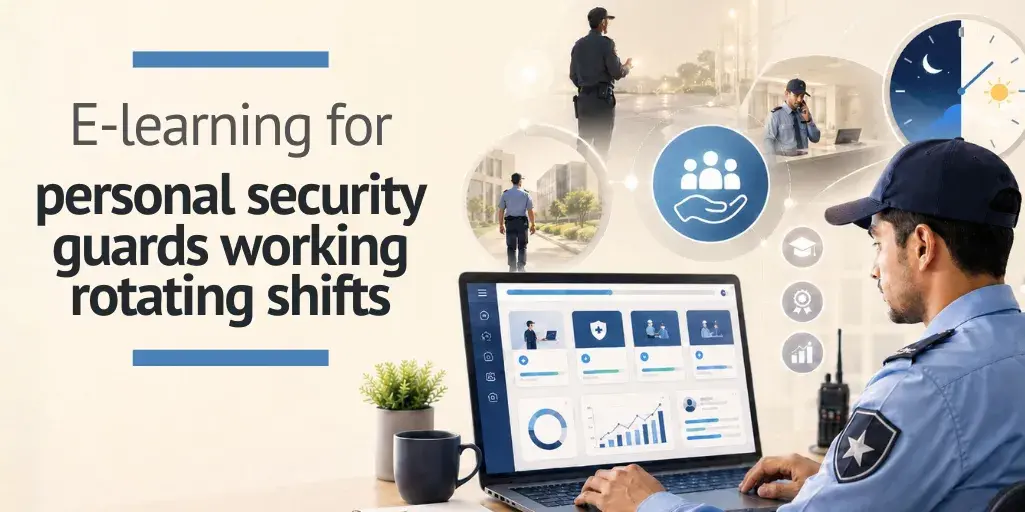
In private security service companies with rotating shifts, well-designed online training in private security reduces early attrition. Not because it replaces pay, but because it supports the personal security guard when there is no classroom, no fixed computer, no stable schedule and no time between one assignment and the next.
Finding qualified professionals is becoming increasingly difficult, but getting them to stay with the organisation long enough to build stable teams is often even harder.
In this context, training for rotating shifts can become a strategic tool for improving the employee experience, strengthening integration within the organisation and increasing long-term engagement.
This article is aimed at HR and operations managers responsible for dispersed workforces and high turnover. You will learn when disengagement typically begins, which training-related warning signs can predict it and what requirements training for rotating shifts must meet to retain talent without disrupting operations.
If your priority is regulatory compliance in the sector, complement this article with how an LMS reduces legal risks in private security.
Why turnover and attrition are a structural problem in private security

Turnover in private security is not solely driven by factors such as pay or working conditions. The way the sector itself operates makes it difficult to build lasting relationships between employees and their organisation, particularly where there are rotating shifts, geographically dispersed assignments and long periods of lone working.
When this reality is combined with limited opportunities for professional development or training focused solely on regulatory compliance, the risk of disengagement increases.
For this reason, it would be a mistake to see attrition purely as a recruitment problem. Personnel retention in private security is closely linked to employees’ experience within the organisation, the opportunities they see for career development and the level of support they receive throughout their professional journey.
A sector where lasting relationships are difficult to build
Turnover in private security is closely linked to the operational characteristics of the sector. Companies need to provide round-the-clock services, manage workforces spread across multiple locations and continually adapt to changes in coverage, staff replacements and new client requirements.
As a result, many personal security guards spend much of their working time with limited contact with both their colleagues and the organisation itself. Unlike other working environments where teams share spaces and routines, private security professionals often spend much of their working day working alone and away from corporate premises.
Over time, this can lead employees to identify more closely with the assignment they perform than with the company they work for. When their connection with the organisation weakens, it becomes more difficult to build lasting working relationships and the risk of attrition increases.
When personal security guards stop seeing opportunities for career development
Personnel retention in private security becomes more challenging when professionals do not see clear opportunities to develop their careers within the organisation.
Many employees receive the training they need to start their role and meet regulatory requirements, but find few opportunities to continue developing their skills, specialise or take on new responsibilities.
When learning stops after the initial onboarding phase, a sense of professional stagnation can easily set in. People need to feel that they are progressing, learning and developing.
When a personal security guard cannot see a clear career path within the company, they are more likely to look for new opportunities elsewhere.
By contrast, when there is an ongoing training in private security strategy focused on skills development and career progression, learning becomes a factor that strengthens engagement and encourages employees to stay with the organisation.
The warning signs that often appear before attrition
Attrition in private security rarely happens suddenly. In most cases, it is preceded by a process of disengagement that can be identified if the organisation has the right monitoring mechanisms in place.
Some of the early signs of disengagement that can be detected include:
- Inactivity on the platform for more than X days among recently onboarded personal security guards.
- Mandatory courses repeatedly started but not completed.
- Repeated access to basic content covering protocols the employee has already been trained on.
- No access to refresher content after the first solo assignment.
- Lack of interest in optional specialist learning pathways.
The problem is that these signs often go unnoticed when employees work far from head offices and have limited contact with the organisation. In many cases, the company only becomes aware of the problem once the decision to leave has already been made.
This is why identifying these indicators at an early stage makes it possible to intervene before disengagement turns into attrition.
Understanding how employee engagement evolves is one of the first steps for organisations looking at how to reduce turnover in security companies sustainably.
Early attrition and its operational and financial consequences

Attrition in private security has an impact that goes far beyond the vacancy left by an employee. Every departure generates direct and indirect costs that affect profitability, service quality and the organisation’s ability to maintain consistent operational standards.
The higher the turnover rate, the more resources the company must devote to covering absences, training new recruits and rebuilding knowledge that had already been developed.
For this reason, understanding the consequences of attrition is essential for any organisation seeking to understand how to reduce turnover in security companies. Before looking for solutions, it is important to assess the true scale of the problem.
What a company really loses every time a personal security guard leaves
Attrition in private security has an impact that goes far beyond filling a vacancy. Every departure means starting a new recruitment process, devoting time to onboarding and allowing for an adjustment period during which the new professional is not yet fully familiar with the procedures, premises or specific requirements of the assignment.
Furthermore, when an employee leaves the organisation, some of the knowledge they have built up through experience is also lost. Even when protocols are documented, there are operational judgements, working habits and practical knowledge that can only be acquired after months or years of working on a particular assignment.
This ultimately affects quality as well. New professionals need time to reach the same level of autonomy and effectiveness as those who are already familiar with the environment, while more experienced employees often have to take on additional support and mentoring responsibilities.
As a result, operational costs increase, service continuity becomes harder to maintain and it becomes more difficult to ensure consistent quality standards.
For this reason, organisations exploring how to reduce turnover in security companies are not simply trying to reduce employee departures. They are also seeking to protect internal knowledge, improve team stability and provide a more consistent experience for their clients.
Checklist: 5 decisions HR should make before implementing online training for personal security guards
- Is the main problem staff turnover or attrition during the first few months?
- Which groups are at greater risk of disengagement?
- Do employees have enough time and genuine access to training?
- What knowledge is critical to ensuring service quality?
- How will employee engagement and development be measured?
The role of continuous training in motivating security personnel

Continuous training in private security supports retention when personal security guards see immediate value in their day-to-day assignments, not when it simply adds more hours to their schedules.
Continuous training in private security helps improve motivation by enabling professionals to feel that they are continuing to develop, acquire new skills and increase their value within the organisation.
Training also acts as a permanent channel of connection. It is not about delivering more courses or increasing the number of hours devoted to learning, but about creating training experiences that provide genuine value to employees and help them deal more effectively with the challenges they face in their day-to-day work.
Training as a tool for building professional confidence
Continuous training in private security helps improve employee retention because it strengthens two fundamental factors: confidence in their own abilities and the perception that the company is committed to their professional development.
When a personal security guard acquires new skills, develops deeper knowledge in specific areas of security or receives support in dealing with complex situations, their sense of preparedness and autonomy increases.
This confidence is particularly valuable in a sector where much of the work is carried out alone and where decisions often need to be made quickly and with sound professional judgement.
At the same time, continuous learning sends an important message: the organisation believes that its professionals’ development is worth investing time and resources in. This perception helps to strengthen their connection with the company and reduces the sense of stagnation that can arise in roles where opportunities for promotion are limited.
For this reason, the answer to how training influences the retention of security personnel lies not only in the knowledge acquired. It is also linked to the confidence, recognition and development prospects employees perceive throughout their professional
Onboarding and the first few months: the critical period
Onboarding in security companies plays a decisive role because a significant proportion of voluntary departures occur during the first few months of employment. This is when professionals form their first impressions of the organisation, assess whether their expectations before joining have been met and decide whether they genuinely want to remain part of the organisation.
Many companies focus much of their effort on attracting talent and completing recruitment processes, but pay less attention to what happens after hiring. However, the real test begins when the personal security guard faces the operational realities of the role.
During this initial stage, new recruits have not yet built strong relationships with the company or gained the experience needed to operate with complete confidence in their new environment. For this reason, any difficulty can have a much greater impact than it would on an established professional.
A procedure they do not understand, an unexpected incident or a perceived lack of support can cause frustration and raise doubts about their decision to join the organisation.
In addition, new employees tend to continually compare the reality they encounter with the expectations they had formed during the recruitment process. When there is a significant gap between the two, the risk of early disengagement increases.
The first few weeks should therefore be seen as a strategic phase of integration and support, as this is precisely when the foundations of the future relationship between the employee and the company are established.
The risks of the first solo assignment
One of the most sensitive stages of onboarding in security companies occurs when professionals undertake their first assignments without direct supervision or with a high degree of autonomy.
Even if they have received initial training, questions often arise when situations move into a real-world context. Procedures that seemed straightforward during training can become more complex when operational constraints, time pressure or unexpected circumstances come into play.
In these situations, many personal security guards experience a sense of uncertainty that they do not always communicate to the organisation. The problem is that this uncertainty can affect both their performance and their perception of the working experience.
When employees feel they have to face situations alone before they consider themselves fully prepared, the risk of frustration increases and confidence in their own abilities declines.
This situation can accelerate attrition that, in many cases, could be prevented through appropriate support mechanisms.
How to strengthen onboarding in security companies
The best way to strengthen onboarding in security companies is to view induction as a gradual process rather than a one-off event that ends once initial training has been completed.
Adjustment takes time. Professionals need access to resources that allow them to resolve questions, check procedures and reinforce their knowledge as new situations arise in their day-to-day work.
In this respect, continuous learning during the first few months is often far more effective than concentrating all training in the days before an employee starts their role.
It is also important for employees to feel that a support system remains in place beyond the initial stage. Knowing where to find information, having access to readily available content and maintaining an ongoing connection with the organisation all help to reduce the sense of isolation that can arise during those first assignments.
Ultimately, companies looking at how to prevent security personnel attrition often find that the key lies not only in improving recruitment processes, but also in providing professionals with the right support during the period when they are most vulnerable to disengagement.
Flexible training for rotating shifts and lone working

Training for rotating shifts allows professionals to access learning when they are genuinely able to do so, without depending on fixed schedules, travel or face-to-face sessions that are difficult to fit around the sector’s operational demands.
Given the characteristics of the security sector, flexibility is a necessity for personal security guards. This is one of the reasons why corporate e-learning has become increasingly prominent in the sector’s training strategies.
Unlike models designed for employees who share an office or regularly work at the same location, digital training can adapt to a far more complex and dispersed working environment.
Why traditional training models do not work for private security
Training for rotating shifts is difficult to manage through traditional face-to-face models. Organising in-person training that accommodates the diversity of the sector, particularly in terms of working hours and geographical locations, often involves significant logistical costs and complex planning.
Moreover, the day-to-day reality of the sector means that many professionals have little opportunity to travel to training centres or attend face-to-face sessions outside their usual working hours.
When training requires excessive organisational effort, there is a greater risk that employees will see it as an additional obligation rather than a development tool. The risk of early training drop-out also increases.
What truly effective training for rotating shifts requires
Effective training for rotating shifts must adapt to employees’ availability rather than forcing employees to adapt to the training system.
Accessibility is one of the most important factors. Content should be available whenever professionals need it, regardless of their location or the hours they work.
The learning experience should also be simple, intuitive and compatible with the devices employees use regularly.
It is equally important for training to maintain a direct connection with the real challenges personal security guards face in their day-to-day work. The more useful employees find the content they receive, the more engaged they will be with the learning process and the easier it will be to establish sustainable long-term learning habits.
Microlearning, mobile access and learning at any time
Corporate e-learning is particularly well suited to this context because it allows content to be delivered in short formats that are accessible and compatible with the sector’s operational pace.
Microlearning methodologies enable employees to complete small units of learning whenever they have a suitable window of time. Instead of requiring long training sessions, knowledge is delivered through specific content that can be accessed quickly and practically.
Another key advantage is the ability to access training from mobile devices. As many personal security guards do not have access to a computer during their working day or cannot easily attend a training room, smartphones become a key tool for ensuring continuity of learning.
This combination of short-form content, mobile accessibility and permanent availability enables training to adapt more effectively to the operational realities of professionals working across dispersed assignments and changing schedules.
The value of learning adapted to the personal security guard’s operational pace
| Sector requirement | Traditional face-to-face training | Training for rotating shifts through e-learning |
|---|---|---|
| Variable schedules | Requires specific sessions and simultaneous attendance. | Allows flexible access to training at any time. |
| Dispersed assignments | Requires travel or the organisation of multiple sessions. | Enables access from any location, regardless of workplace. |
| Lone working | Makes it difficult to provide ongoing support to each professional. | Provides resources that are permanently available to answer questions or reinforce content. |
| Frequent assignment changes | Requires training to be constantly rescheduled. | Allows content to be updated immediately. |
| Large workforces | Creates a high administrative workload. | Automates enrolments, monitoring and training management. |
| Access to information | Is limited to the specific moment when training takes place. | Allows ongoing consultation whenever a need arises. |
| Knowledge reinforcement | Requires new sessions to be organised. | Enables automated periodic reinforcement. |
| Individual monitoring | Is complex and manual. | Provides full traceability of each person’s learning. |
The difference between these models does not lie solely in the technology used. What truly matters is that online training for rotating shifts removes many of the barriers that have traditionally made learning difficult within the private security sector.
When training is adapted to the workforce’s actual operational reality, it becomes easier to maintain an ongoing professional development strategy without disrupting service delivery.
Not all professionals start with the same level of experience or face the same situations in their day-to-day work. For this reason, the most effective training models are those that make it possible to personalise learning pathways, reinforce content when necessary and provide resources tailored to each professional profile.
In this respect, adaptive learning makes it possible to create experiences that are far more efficient and relevant to each user. In fact, an e-learning platform based on adaptive learning can adjust content and recommendations according to each learner’s behaviour and needs, providing a more personalised and effective training experience.
When training adapts to employees rather than forcing employees to adapt to training, participation is more likely to increase, the learning experience improves and the connection with the organisation becomes stronger.
Monitoring, support and early detection of attrition

Training for rotating shifts offers an additional benefit that many organisations do not initially consider: it helps create visibility over workforces that operate in dispersed locations and have limited face-to-face contact with the company.
In a sector where many professionals work across different locations and schedules, understanding each employee’s day-to-day reality is particularly complex.
For this reason, training can become much more than a learning tool. It also provides useful information for understanding how the workforce is evolving, identifying support needs and enabling closer management, even when teams are geographically dispersed.
The challenge of managing dispersed teams
Managing a private security and guarding service involves a challenge that is not usually seen with the same intensity in other sectors: a large proportion of the workforce carries out its work away from the company’s offices, with few opportunities for face-to-face interaction with managers and colleagues.
As a result, HR managers have fewer opportunities to understand first-hand how each professional is progressing, what they need or what difficulties they are facing in their day-to-day work.
This creates an important challenge. How can an organisation properly support employees it rarely sees? How can it identify support needs when everyday contact is limited?
Answering these questions is essential to building more stable and engaged teams.
What training activity can reveal
Continuous training in private security generates highly valuable information for better understanding the workforce’s reality and enabling closer management of professionals.
Beyond the knowledge acquired, training activity makes it possible to observe aspects such as participation, learning pace, interest in specific content and areas where employees need greater support.
This information helps HR managers gain a much more complete view of the organisation, especially when managing large numbers of employees distributed across multiple assignments.
For example, detecting that certain groups repeatedly struggle with a specific procedure can help reinforce particular content. Similarly, identifying which skills generate the greatest interest makes it possible to design pathways that are better aligned with professionals’ expectations.
Training therefore ceases to function solely as a mechanism for transferring knowledge and also becomes a source of strategic information about the workforce’s real needs.
How to act before problems arise
Personnel retention in private security improves when the organisation has mechanisms that allow it to support employees continuously, not only when an incident or conflict arises.
Having periodic information on workforce development makes it easier to identify training needs, adaptation difficulties or areas where specific professionals may require additional support at an early stage.
In many cases, small interventions at the right time prevent minor issues from becoming more complex situations.
This also helps reinforce employees’ perception of closeness. Even when they work alone or in locations far from head office, they can feel that their professional development is being genuinely monitored and that the organisation is interested in their growth.
In a sector where geographical dispersion is part of everyday reality, having tools that facilitate ongoing support is a significant advantage for any strategy aimed at reducing turnover and strengthening long-term team engagement.
Training, belonging and professionalisation of the sector

Continuous training in private security contributes to the professionalisation of the sector by helping to build a shared culture, reinforce quality standards and show employees that their professional development is part of the organisation’s strategy.
Private security is a sector in which many professionals carry out their work on third-party premises. As a result, personal security guards often identify more closely with the assignment they perform every day than with the organisation they belong to.
For this reason, creating a sense of belonging is one of the major challenges facing security companies.
Strengthening the professional identity of personal security guards
Training in private security strengthens professional identity by helping employees better understand the value of their role and the impact it has on the people, organisations and environments they protect.
Security work is often viewed solely from an operational perspective. However, every assignment involves a significant level of responsibility related to protecting assets, preventing risks and managing potentially complex situations.
Training helps to put these responsibilities into context and reinforce the importance of the professional’s role.
In addition, continuous learning helps to establish a culture of ongoing improvement. Personal security guards no longer see themselves simply as people who follow procedures, but begin to identify as professionals who develop skills, acquire specialist knowledge and progress within an increasingly demanding discipline.
Creating a shared culture across dispersed workforces
Personnel retention in private security also depends on a company’s ability to create a shared culture among employees who rarely meet in person.
Unlike other sectors where daily interaction helps build shared values, security companies need to find alternative ways to communicate their working practices, procedures and organisational principles. Otherwise, there is a risk that each assignment will evolve as a separate environment, with its own dynamics and criteria.
Training is one of the most effective tools for building this cohesion. Through shared content, best practices, protocols and common learning spaces, organisations can strengthen an organisational identity that transcends geographical and operational differences.
In this respect, learning acts as a common language that can connect professionals working in very different contexts but who are all part of the same organisation.
Professionalising private security and guarding services
Continuous training in private security raises the level of professionalisation by helping to standardise knowledge, improve the quality of professional practice and reduce reliance on informal practices passed on in an improvised way.
More advanced organisations understand that the quality of a private security service does not depend solely on physical resources or operational coverage. It is also directly related to the level of preparation of the professionals delivering the service and the company’s ability to ensure consistent standards of practice.
When training forms part of the business strategy, it becomes easier to maintain consistent standards, introduce new working methods and adapt to regulatory or technological changes affecting the sector.
All of this has an impact both on the employee experience and on clients’ perception of the service they receive.
Ultimately, companies that invest in professional development also help strengthen the image of the sector as a whole. Every step towards greater professionalisation helps build stronger organisations, better-prepared teams and services that deliver greater added value for clients and users.
How an LMS platform can help in this context

Frequently asked questions about training for rotating shifts and retention in private security