E-learning platforms are transforming surgical training by enabling continuing medical education that is traceable and closely connected to real clinical practice.
Surgery has always been synonymous with precision, responsibility and continuous learning. New techniques, devices and innovative protocols are constantly emerging that force surgical professionals into an ongoing race against the obsolescence of knowledge.
Surgery requires continuing medical education that cannot rely solely on conferences or occasional training placements. New techniques, devices and protocols require surgeons to learn continuously and remain closely connected to real clinical practice.
In this context, e-learning platforms are becoming a robust infrastructure capable of sustaining online surgical training over time, integrating knowledge, hands-on practice and professional collaboration beyond isolated events.
From a course repository to a surgical learning ecosystem
Talking today about a digital training infrastructure applied to surgery means building a digital environment that goes far beyond a simple course repository. It requires that continuing medical education be fully integrated with real clinical practice, advanced simulation, clinical case analysis and collaboration between specialists from different centres and countries.
The LMS for continuing medical education thus becomes an ecosystem that provides continuity, learning traceability and analytical capabilities, turning training into a living process aligned with the evolution of digital surgery.
Throughout this article, we will explore how LMS platforms are redefining the way surgeons learn, share knowledge and stay up to date in a discipline where the margin for error is minimal and training demands are at their highest.
LMS for surgery: the new training ecosystem for surgeons
A LMS for surgery now acts as the central backbone of modern surgical training, enabling structured continuing medical education aligned with real clinical practice. In an environment where technological innovation moves at speed, this infrastructure ensures accessibility, learning traceability and adaptation to real clinical schedules.
The evolution of digital surgery has transformed the surgeon’s competency profile. Alongside traditional technical skills, new demands have emerged related to robotics, the adoption of advanced medical devices, the interpretation of clinical data and the continuous updating of protocols.
As a result, an LMS for healthcare professionals is no longer a simple training support tool but becomes a true learning operations centre, capable of centralising content, connecting specialists and adapting to complex clinical agendas.
A specialised e-learning environment for surgeons responds to these needs by integrating different learning formats and experiences that complement one another, adapted to the different learning styles in digital environments that coexist within surgical teams.
In summary, this training ecosystem enables:
- Access specialised content anytime, anywhere, making it easier to balance clinical activity with ongoing learning.
- Integrate advanced audiovisual resources, such as operating room videos, enabling the analysis of real procedures, pausing at critical moments and reflecting on technical decisions.
- Incorporate simulation and clinical cases, strengthening the practical understanding of new techniques and reducing the learning curve before their application in the operating theatre.
- Adapt the learning pace to different levels of experience, which is essential in teams where trainees, junior specialists and senior surgeons work side by side.
- Promote collaborative learning, creating professional communities where knowledge can be shared, therapeutic approaches discussed and clinical experiences compared.
Asynchronous access offered by a medical e-learning platform addresses one of the main limitations of traditional training: lack of time. Surgeons can return to content when they need it, review a procedure before applying it, or explore a specific technique in greater depth without relying on rigid schedules.
This capability is particularly relevant in healthcare environments under high clinical pressure, where continuing medical education cannot be limited to isolated events.
In addition, this model helps reduce inequalities in access to knowledge, enabling professionals from different centres and geographical contexts to access the same training resources.
In the same way that e-learning platforms can help reduce the digital divide, well-applied technology can become a key ally in democratising access to specialised healthcare training.
Overall, the connected surgeon moves away from fragmented and reactive learning to adopt a continuous, structured and collaborative model. The LMS for surgery is thus consolidated as the foundation on which a new training ecosystem is built, ready to integrate medical conferences, telementoring and real clinical practice.
E-learning platforms in surgery: continuing medical education beyond the congress
E-learning platforms in surgery allow continuing medical education to move beyond reliance on one-off events and become a process sustained over time. Compared to a model based on annual conferences, a surgical teletraining platform offers continuity, follow-up and a professional community throughout the year, aligning with the constant evolution of clinical techniques and protocols.
This approach responds to an obvious reality: continuing medical education cannot wait for a specific date in the calendar when techniques, devices and protocols are evolving continuously.
What happens to the knowledge acquired once the congress comes to an end?
How is it consolidated, updated and shared with those who were unable to attend?
This is where a medical e-learning platform acts as the common thread that keeps the learning community alive beyond the face-to-face event.
The hybrid model: medical congresses and surgical e-learning
The hybrid model enabled by a LMS for surgery, far from replacing the congress, enhances it. It allows medical conferences to be integrated into a hybrid framework by preparing content before the event and consolidating learning afterwards through materials, assessments and accreditations. In this way, online surgical training supports surgeons before, during and after the scientific meeting, transforming a one-off event into a continuous learning process.
From an operational perspective, this hybrid approach makes it possible to structure different learning phases that reinforce one another:
- Before the congress, the platform provides preparatory materials, clinical guidelines, operating room videos and level-assessment tests that help standardise knowledge and maximise the value of face-to-face sessions.
- During the event, the virtual campus can integrate live streams, discussion spaces and supporting documentation, allowing learning to extend beyond the physical venue and reach professionals participating remotely.
- After the congress, the medical LMS becomes the space where learning is consolidated through case summaries, clinical discussions, assessments and automatic certifications that ensure continuity of the training experience.
This model becomes especially valuable when medical telementoring is incorporated as part of the learning process. The opportunity to rely on senior surgeons who guide, supervise and comment on procedures in controlled environments adds a layer of value that is difficult to achieve through traditional training. Through secure surgical broadcasts, post-procedure analysis or remote mentoring sessions, the platform enables the structured and traceable transfer of expert knowledge.
In this context, learning ceases to be one-directional and becomes a collaborative process. The e-learning platform for surgeons allows trainees, specialists and mentors to share criteria, discuss clinical decisions and reflect on real outcomes. This dynamic strengthens a culture of continuous improvement and reduces the gap between theory and practice — a key factor in disciplines where accumulated experience makes a real difference.
In addition, the use of an LMS for healthcare professionals as a complement to congresses and clinical practice opens the door to adaptive learning models that allow training to be highly personalised. Learning pathways can be tailored according to specialty, level of experience or clinical interests. In this way, technology moves beyond being a simple channel to become a genuine enabler of surgical learning.
Ultimately, the combination of medical congresses, clinical practice and online surgical training through a surgical teletraining platform redefines how surgeons stay up to date and share knowledge.
The result is a hybrid model that brings continuity, coherence and depth to learning, laying the foundations for surgical training that is truly aligned with the challenges of modern medicine.
Requisitos clave de un LMS para la formación quirúrgica
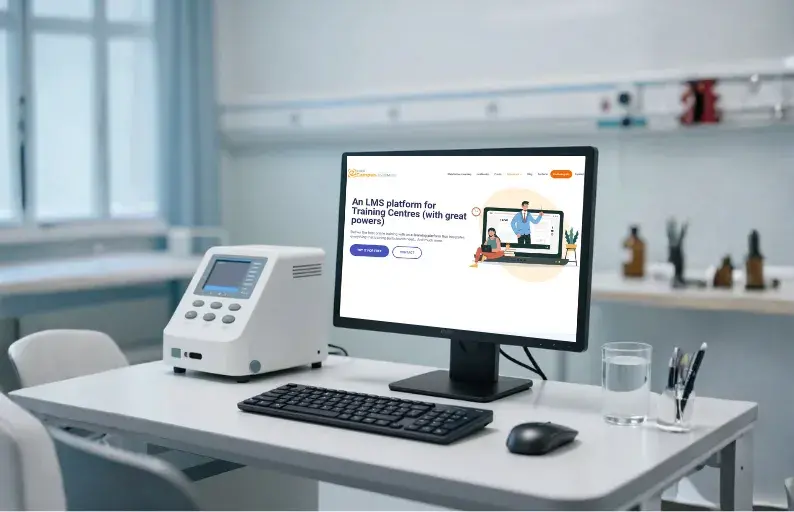
A LMS for surgery must meet very different requirements from those of other training domains. Online surgical training involves working with highly specialised knowledge, sensitive data and learning processes that directly influence clinical practice.
For this reason, a healthcare e-learning platform cannot be limited to delivering digital content alone; it must ensure security, traceability, pedagogical rigour and the ability to adapt to a constantly evolving clinical environment.
When we talk about a medical LMS, we are referring to a critical infrastructure for continuing medical education among healthcare professionals. Choosing the right platform means ensuring that learning takes place in a reliable, assessable way and remains aligned with industry standards.
High security, privacy and traceability in a medical LMS
Security is a structural requirement in any medical e-learning platform, but it becomes especially critical in surgery.
Training content may include real clinical cases, procedure recordings and data linked to professional accreditations. All of this requires encrypted environments, role-based access control and strict compliance with data protection regulations.
A LMS for healthcare professionals must provide full learning traceability: which content has been accessed, which assessments have been completed and which competencies have been acquired. This traceability not only builds trust among professionals but is also essential for hospitals and medical societies that require objective evidence of the training delivered.
Integration of video, surgical simulation and hands-on learning
Surgery is learned by observing, analysing and practising. For this reason, advanced video integration is a core pillar of any e-learning platform for surgeons.
Access to operating room videos makes it possible to study real techniques, review critical decisions and understand nuances that are difficult to convey through purely theoretical formats.
Alongside video, surgical simulation enables surgeons to train new techniques and make clinical decisions in safe environments before real-world application, reducing the learning curve and clinical risk.
A LMS for surgery must be capable of integrating interactive simulations, anatomical models and advanced visual resources that reinforce hands-on learning and shorten the adaptation curve to new procedures.
Competency-based assessment and clinical cases in surgery
In online surgical training, assessment is not limited to verifying theoretical knowledge. Surgery requires clinical judgement, decision-making skills and the ability to analyse complex situations.
For this reason, a medical LMS must incorporate assessment systems that go beyond traditional tests.
Case-based assessments, competency rubrics and self-assessment or peer-review processes allow learning outcomes to be measured in a more realistic way.
This is particularly relevant in environments where different levels of experience coexist and where the healthcare e-learning platform must adapt to both trainees and senior surgeons.
Certification, accreditations and continuing medical education
Automatic certification is another key component of a LMS for healthcare professionals.
The ability to generate certificates, record training hours and accredit competencies automatically reduces administrative workload and brings transparency to the learning process.
In the field of continuing medical education, this record is essential to ensure the validity of training before scientific societies and accrediting bodies.
A well-configured LMS makes it possible to centralise all this information and turn training into an organised, verifiable and aligned process that supports continuous professional development requirements.
Advanced analytics and monitoring of surgical learning
Finally, a medical LMS must provide clear visibility into what is happening throughout the training process.
Participation, progress and performance data make it possible to identify learning patterns, detect difficulties and improve continuing medical education programmes.
Advanced analytics, supported by artificial intelligence applied to LMS platforms, enable more precise and proactive monitoring. This makes it possible to anticipate drop-off risks, identify areas for improvement and adjust learning pathways so that the e-learning platform responds dynamically to the real needs of professionals.
Taken together, these requirements define what truly distinguishes an LMS for surgery from a generic training platform. When security, practice, assessment and analytics are integrated into a single environment, technology moves beyond being a simple support tool and becomes a strategic ally for surgical learning.
Artificial intelligence and personalised learning in surgical training

In surgical training, artificial intelligence applied to an LMS makes it possible to personalise learning pathways, recommend content and analyse learning progress without replacing clinical judgement.
Far from substituting clinical judgement, AI acts as a support layer that optimises the way surgeons learn, stay up to date and consolidate competencies over time. Its value lies in supporting training with more precise recommendations, flexible pathways and a learning experience aligned with real clinical practice.
The surgical environment is inherently heterogeneous. Trainees acquiring basic skills, specialists seeking to deepen specific techniques and senior surgeons contributing expert knowledge all coexist within the same ecosystem.
Does it make sense for everyone to follow the same learning pathway?
A medical LMS with AI capabilities can interpret these differences and adapt content accordingly, avoiding generic approaches that add little real value to the learning process.
Personalisation of surgical learning through AI
One of the main contributions of AI within an e-learning platform for surgeons is its ability to analyse learning behaviour. The system identifies which content generates the greatest interest, where difficulties tend to concentrate and which resources are used most frequently.
Based on this data, the LMS for healthcare professionals can suggest specific materials, reinforce key concepts or propose learning pathways aligned with the surgeon’s specialty and level of experience, supported by adaptive learning models that personalise training.
AI also plays a relevant role in scientific updating. The volume of information available in medicine continues to grow, and filtering what is truly relevant requires time.
In this context, intelligent assistants integrated into a healthcare e-learning platform can help prioritise content, summarise clinical documents or highlight significant changes in guidelines and protocols. As a result, learning becomes more efficient and better connected to the reality of the operating theatre.
In addition, advanced analytics makes it possible to anticipate situations that affect learning. An AI-enabled LMS for surgery can detect patterns of low participation, recurring difficulties or risk of drop-off, enabling early intervention to reinforce continuing medical education before it is compromised. This predictive insight delivers value both to professionals and to the organisations responsible for training.
It is important to emphasise that artificial intelligence does not replace the human component of surgical learning. Clinical reflection, the exchange of perspectives and expert guidance remain irreplaceable.
Technology acts as a support layer that provides context, personalisation and efficiency within an e-learning platform designed to foster collaborative learning.
Taken together, artificial intelligence integrated into an LMS for surgery helps make training more relevant, personalised and sustainable over time. By supporting continuing medical education and adapting to the real needs of each surgeon, AI moves beyond being a technological promise to become a practical tool in the service of surgical learning.
How an LMS for healthcare enhances collaboration between hospitals, societies and manufacturers
A digital training environment in healthcare makes it possible to connect, in a stable way, the different stakeholders involved in surgical training. Hospitals, medical societies and manufacturers share the same challenge: ensuring that online surgical training is coherent, up to date and aligned with real clinical practice. An LMS for healthcare professionals acts as the shared space where this collaboration moves beyond one-off initiatives and becomes part of a continuous process.
Training in surgery does not depend on a single actor. Hospitals train and supervise their teams, medical societies define standards and accredit competencies, and manufacturers introduce new technologies that require specific training.
Without a shared infrastructure, this ecosystem can easily become fragmented. A medical LMS makes it possible to integrate all these stakeholders into a single environment, with access control, traceability and clearly defined training objectives.
From a hospital perspective, an e-learning platform for surgeons facilitates the standardisation of continuing medical education. Content is aligned with internal protocols, progress is recorded and knowledge updates are delivered consistently, even within organisations that operate across multiple sites or services. This brings coherence and reduces variability in clinical practice.
For medical societies, an LMS for surgery provides an effective channel to disseminate clinical guidelines, structure learning pathways and assess competencies. The platform allows training credits to be recorded, participation to be tracked and the real impact of programmes to be measured, strengthening transparency and the quality of accredited training.
Medical technology manufacturers also find in a surgical teletraining platform a suitable environment to train professionals in new techniques and devices. Through the LMS, they can combine theoretical content, operating room videos, medical telementoring sessions and assessments that ensure correct adoption of the technique — all within a secure framework aligned with clinical criteria.
This collaborative model delivers clear benefits. Training becomes standardised, travel and logistical costs are reduced, and programme reach is expanded without relying exclusively on face-to-face delivery. LMS platforms for training centres make it possible to scale training and adapt it to different organisational realities within the healthcare sector.
In addition, working within an LMS for healthcare professionals fosters a culture of shared learning. Surgeons participate actively, exchange experiences and contribute to enriching content based on real clinical practice. Knowledge no longer circulates in isolation but becomes a collective asset.
Taken together, an e-learning platform for healthcare acts as the connecting element that brings hospitals, societies and manufacturers together within a shared training ecosystem, creating a collaborative approach that lays the foundations for training that is more coherent, scalable and aligned with the real demands of modern surgery.
Checklist for choosing an e-learning platform in surgery
Choosing an e-learning platform for surgeons is not an isolated technological decision, but a strategic choice with a direct impact on the quality of online surgical training and its application in clinical practice.
An LMS for surgery must be capable of sustaining training over time, adapting to different professional profiles and meeting the specific requirements of the healthcare environment. For this reason, before implementing a solution, it is essential to evaluate carefully what the platform truly offers and how well it fits the real needs of hospitals, medical societies or manufacturers.
This checklist serves as a practical guide to assess whether a healthcare e-learning platform is prepared for the surgical context. It is not about accumulating features, but about ensuring that the key elements are well integrated and aligned with training needs, security requirements and hands-on learning.
Using an evaluation tool like this helps compare options more objectively and supports informed decision-making.
| Criterion | What to assess in an e-learning platform for surgery |
|---|---|
| Security | Regulatory compliance, data encryption, role-based access control and protection of clinical and training information. |
| Video and simulation | Integration of operating room videos, support for HD content, surgical simulation and advanced visual resources. |
| Assessment | Competency-based assessment systems, clinical case analysis, self-assessment and peer review. |
| CPD and certification | Automatic certificate generation, tracking of training hours and traceability of continuing medical education. |
| AI | Use of artificial intelligence applied to LMS platforms to personalise learning pathways, analyse progress and anticipate training needs. |
| Accessibility | Asynchronous access from different devices and support for reducing the digital divide in online learning. |
| Collaboration | Tools for collaborative learning, clinical forums, cross-centre work and participation of mentors and experts. |
Beyond this checklist, it is important to consider a key question: does the platform truly support surgeons in their day-to-day work, or does it simply deliver isolated content?
A medical LMS focused on surgery should facilitate integration between learning, clinical practice and the professional community, minimising friction and delivering value from the very first use.
In this sense, choosing a specialised e-learning platform for professional training provides a flexible technological foundation, capable of adapting to different training contexts within the healthcare sector. The key lies in selecting a solution that not only meets current needs but is also prepared to evolve alongside digital surgery and new learning models.
Quick answers about e-learning platforms and surgical training
What is an e-learning platform for surgery?
Why is an LMS key in modern surgical training?
What role does surgical simulation play in e-learning?
How is artificial intelligence used in online surgical training?
Surgical training as a continuous and connected process
The evolution of surgery requires a training model that supports professionals beyond isolated moments. In this context, e-learning platforms in surgery are becoming the foundation that sustains continuing medical education, integrating learning, clinical practice and collaboration within a single environment.
An LMS for surgery makes it possible to connect theoretical content, surgical simulation, operating room videos, telementoring and professional accreditation in a coherent and traceable way. Training is no longer fragmented and instead becomes a continuous process, aligned with the ongoing medical updating required by modern surgical practice.
The integration of artificial intelligence strengthens this model by enabling personalised learning pathways and more precise monitoring of progress, without replacing clinical judgement. At the same time, e-learning platforms for healthcare encourage collaboration between hospitals, medical societies and manufacturers, expanding the reach and coherence of online surgical training.
Ultimately, choosing an e-learning platform for surgeons designed for the healthcare environment means recognising that learning in surgery is not a one-off event, but a continuous, connected process that is essential to the quality of patient care.
Frequently asked questions about e-learning platforms and surgical training

How do surgeons use e-learning platforms?
What features should an LMS for surgical training have?
How are medical congresses integrated with LMS platforms?
What benefits does AI offer in the training of surgeons?
Artificial intelligence in the training of surgeons enhances continuous knowledge updating by personalising learning pathways, recommending relevant content and analysing learning progress. When applied within an LMS for healthcare professionals, AI optimises study time and enables more efficient updating without replacing clinical judgement.