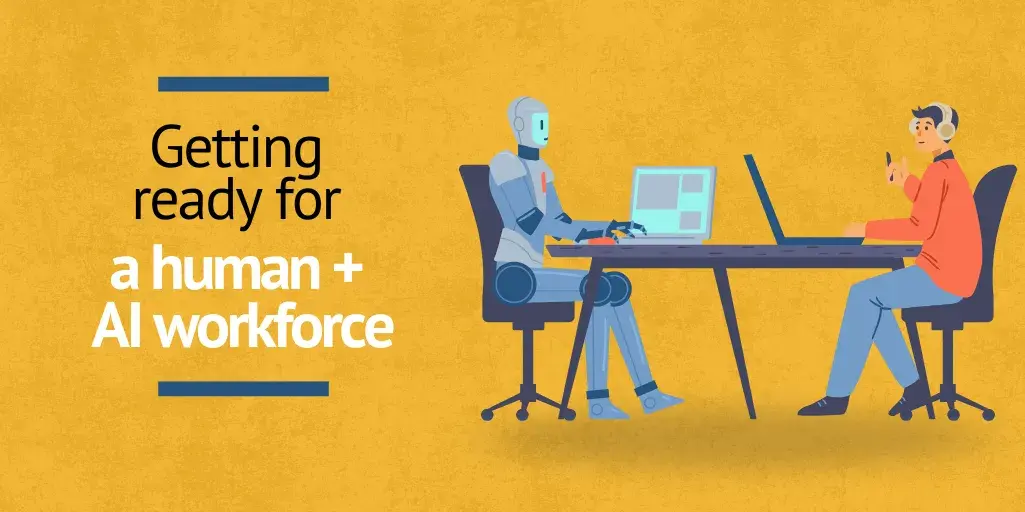
This shift requires organisations with genuine learning agility, able to develop capabilities such as learning agility, ai fluency, and digital reskilling, which now determine their ability to adapt and stay competitive.
The professionals who will thrive are those who know how to activate, oversee, and harness AI as a partner to human judgement.
In this scenario, smart e-learning platforms — like the e-learning platform by EvolMind — become essential environments for training human + AI teams. They allow teams to learn, practise, and evolve in real time, and prepare organisations for a continuous, in-depth reskilling and upskilling strategy aligned with the real demands of each role.
The new way of working: humans and AI agents together
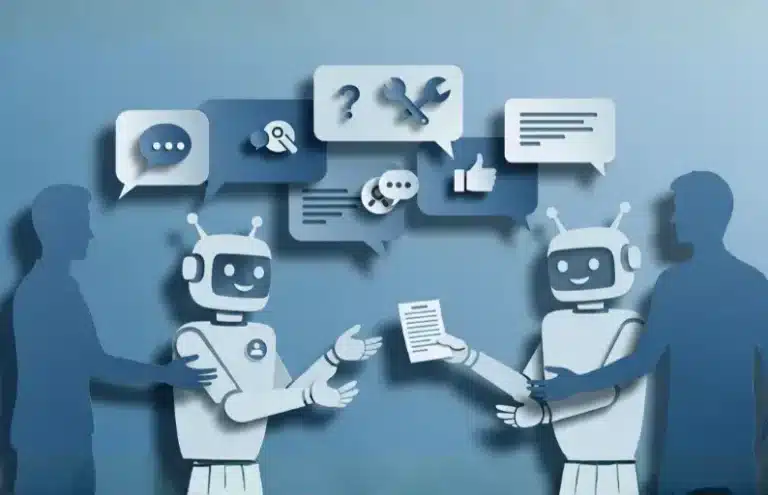
It’s no longer about mastering standalone tools, but about understanding how to activate collaboration between AI and humans to gain efficiency, creativity, and responsiveness.
This model demands organisations with strong learning agility, ready to lead upskilling and reskilling strategies that enable continuous adaptation of roles and capabilities.
Why the work model is changing and what it demands from talent
In this context, AI takes on repetitive tasks — classification, analysis, automation — while humans bring judgement, empathy, and strategic direction.
This shift is only sustainable with a solid framework for continuous learning. That’s why many companies are adopting learning environments that support ongoing skills development, where learning, practice, and supervision take place in one integrated space.
Real examples of human + AI collaboration across sectors
For example:
- In logistics, AI optimises routes and forecasts demand, while people handle incidents and make context-driven decisions.
- In corporate training, AI acts as a learning assistant —adapting content and analysing data— while the trainer focuses on guiding, interpreting, and supporting the learners.
- In marketing, AI agents help uncover ideas and patterns, and professionals define the strategy and ethical tone.
- In industry, predictive maintenance automates alerts and calculations, while the technician assesses risks and makes decisions on site.
How the definition of a “competent worker” is changing

Today, being competent means knowing how to work with intelligent systems: interpreting data, overseeing automated results, and making informed decisions. A strong professional masters concepts like ai fluency and understands what is ai fluency in practice — when to activate AI, how to verify its responses, and how to integrate it into their workflow.
At the same time, communication, creativity, and critical thinking are becoming more valuable, as they amplify what automation cannot replicate.
To keep up, companies need effective digital reskilling strategies to update skills and train professionals to supervise intelligent systems. Modern LMS platforms make it possible to evaluate progress with activities similar to a test learning agility, identifying skill gaps and recommending tailored learning pathways. Tools such as virtual tutors reinforce this approach by offering clear data on learners’ real progress — without using AI — helping organisations make more precise learning decisions.
AI fluency as a major challenge for companies
Developing ai fluency has become a key challenge for any organisation aiming to work with AI strategically. It’s no longer enough to know how to use tools — the real value lies in understanding what is ai fluency in real-world practice: when to activate an AI agent, how to supervise its decisions, what risks to avoid, and how to integrate it into a workflow without losing human judgement. This competence is now just as critical as learning agility, as it enables teams to adapt quickly, correct course, and maximise the value of automation.
What is AI fluency and how it differs from simply “knowing how to use AI”
Ai fluency is not a technical skill or a list of commands. It’s a strategic capability that combines understanding, judgement, and oversight. It means knowing which tasks to delegate, how to interpret the model’s reasoning, and what limitations could compromise a process.
In other words, it’s the difference between “using AI” and “working intelligently with it”.
This fluency is what makes collaboration between AI and humans safe, efficient, and aligned with the organisation’s values. Companies already working with advanced LMS platforms are now integrating specific training content to build this capability at every level — from operational teams to senior management.
Benefits of developing AI fluency across the organisation
- It boosts productivity by reducing analysis and preparation time.
- It lowers errors by training teams to verify information generated by AI models.
- It accelerates learning by enabling digital reskilling.
- It brings more confidence to decision-making, especially in areas where automation must be supervised.
Moreover, when the entire organisation shares clear criteria on how to use AI, it leads to more consistent workflows, more measurable processes, and more traceable decisions. This cultural foundation is essential for continuous learning to succeed — especially in reskilling and upskilling programmes that integrate real use of AI tools into every phase.
Key steps to developing AI fluency in companies
Organisations that are moving forward the fastest share a clear roadmap. It’s not just about training — it’s about creating stable internal practices that turn AI into a reliable ally.
These are the essential stages for developing ai fluency in organisations:
Internal audit: identifying workflows where AI adds value
The first step is to analyse repetitive tasks, workload peaks, data analysis needs, or idle times within each team.
AI creates value when it reduces friction, removes unnecessary steps, or enables more informed decisions.
Many companies use assessment systems within their LMS to collect real data on where these needs appear, supported by tools such as internal employee training solutions.
Human + AI agent pilots: controlled testing
Pilot projects allow organisations to validate which processes should be automated, which require oversight, and where human judgement remains essential.
This phase is crucial to define the model of collaboration between AI and humans, establish metrics, and understand the real impact before scaling the solution.
Continuous training programmes (reskilling and upskilling)
Once the potential is identified, companies must implement reskilling and upskilling pathways that train teams in AI supervision, verification, and critical use.
These programmes work best when delivered through an e-learning platform capable of adapting content to each individual’s pace and measuring progress through practical activities — such as micro supervision exercises or assessments similar to a test learning agility.
This model fits particularly well with platforms like Evolcampus, which allow teams to learn while practising, using integrated AI both for tutoring and for analysing results.
Co-leadership between HR and IT
Ai fluency cannot grow if it’s left solely to the tech department. It requires shared governance: IT contributes technical insight and security; HR defines roles, critical skills, and development pathways.
This co-leadership turns AI into part of the talent, not just part of the system — and supports a more coherent evolution of learning agility and digital reskilling processes.
From courses to continuous learning
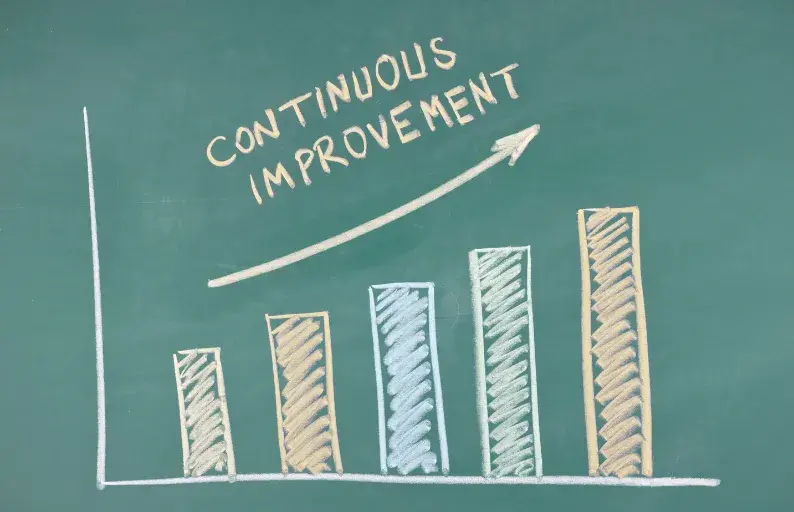
The traditional training model based on “one-off courses” no longer matches the pace of technological change or the evolution of roles within organisations. Today, the key lies in building continuous, dynamic, and work-connected learning systems.
To operate in environments where people and intelligent agents collaborate daily, companies need a framework that enables permanent reskilling and upskilling and strengthens learning agility across all teams.
Why the “course” model is no longer enough
For years, corporate training was organised as a one-off event: a yearly course, a specific workshop, or a closed programme. This worked in stable settings — but has become insufficient in sectors where change arrives in weeks and skills can become outdated within months.
In a very short time, AI has re-entered our organisations, automating tasks, introducing new tools, and constantly reshaping workflows. Now, businesses need learning to become part of everyday work.
That’s why learning agility and digital reskilling have become essential levers for adaptation. The goal of learning is no longer to accumulate knowledge, but to stay ready to interpret, decide, and supervise technologies that are constantly evolving.
And just as technologies evolve continuously, so must learning. It’s simple: either you update your knowledge — or you fall behind.
The role of the LMS as a continuous learning system
This is where modern e-learning platforms come into play, as they serve as the infrastructure for learning within the organisation.
An LMS allows for the centralisation of content, the agile updating of training pathways, and the delivery of experiences tailored to each individual’s pace, making training a continuous process that supports employees in their professional development.
E-learning platforms are designed precisely for these types of environments: they integrate dynamic content, facilitate the creation of personalised learning journeys, and link individual progress to the strategic needs of the business.
Such an LMS also ensures that training is connected to practice, integrating micro-activities, AI simulations, role-specific challenges, and automatic performance analysis. This combination makes it possible for learning to become a culture, rather than a one-off event.
How an intelligent LMS enables continuous learning
A modern LMS has become the cornerstone of continuous learning because it allows each person to progress at their own pace, with flexible paths and content that evolves alongside the changing requirements of their role.
Its value lies not only in storing courses, but in acting as an environment that integrates practice, assessment, tracking, and personalisation. Thanks to AI capabilities, these platforms can recommend resources based on level, progress, or detected needs, reducing friction and enabling more dynamic reskilling and upskilling processes.
Analytics also play a crucial role. An intelligent LMS identifies gaps, tracks learning behaviours, and provides actionable insights so that HR can adjust strategies, anticipate risks, and make data-driven decisions, rather than relying on perceptions. This transforms learning into a living cycle that adapts to each individual, rather than a fixed sequence of content.
Designing learning experiences also requires understanding how each individual learns. In this sense, developing training strategies that consider learning styles or cognitive preferences is useful for creating more effective pathways.
Reflection on which learning styles work in e-learning allows training teams to adjust materials and activities within the LMS to maximise retention and applicability.
How e-learning drives a culture focused on human + AI collaboration

Promoting a culture where people and intelligent agents work together requires a learning system capable of training that interaction in practice. E-learning — and especially intelligent LMS platforms — has become the space where this collaboration can be tested, refined, and improved without risk.
Through simulations, AI-guided activities, and in-depth analytics, organisations can strengthen learning agility, accelerate digital reskilling, and create environments where collaboration between AI and humans becomes a natural habit rather than a leap into the unknown.
The LMS as a human + AI simulation lab
Coexisting with AI is not something you learn by reading theory — it’s learned by trying, adjusting, and observing what happens when automation comes into play. An LMS allows the creation of scenarios where workers can experiment with AI agents in controlled contexts: decision-making simulations, real problem-solving, interactions with models that offer recommendations or instantly detect mistakes.
This type of practice develops critical habits: knowing when to trust, when to verify, how to ask for useful information, and how to interpret the response. In essence, it’s the hands-on training of ai fluency, which complements the conceptual understanding.
Thanks to the flexibility of the e-learning environment, these simulations can replicate business situations without impacting real operations — which helps build team confidence in using AI.
Learning assistants that remove friction
A human + AI culture requires that artificial intelligence also supports learners throughout their learning process. AI-powered assistants act as instant tutors, capable of explaining concepts, solving doubts, or recommending resources tailored to each individual’s needs. This kind of support reduces the feeling of being stuck — one of the main reasons people drop out of online training.
Moreover, by offering real-time support, these agents boost learning agility: they allow people to learn exactly when the doubt arises, not hours or days later. This helps individuals integrate AI naturally into their learning process — making it easier to later integrate it into their daily work tasks.
Performance analytics for HR and training managers
Learning processes that combine the human factor with AI also require measurement, comparison, and adjustment. The advanced analytics in an LMS allow you to identify skill gaps, monitor progress levels, spot friction points, and detect behavioural patterns.
With tools like evolMentor, talent managers can analyse real team trends, identify reskilling and upskilling needs, and anticipate risks before they result in lost efficiency or critical mistakes.
This level of analytics goes far beyond the traditional “course completed” metric. It makes it possible to understand how people learn, at what pace, which competencies are being consolidated, and which skills still need reinforcement. In an environment where roles evolve quickly and AI constantly reshapes tasks, this kind of visibility is essential for guiding training strategy.
Benefits of the human + AI model applied to e-learning
The integration of e-learning as the foundation for human + AI learning brings direct benefits in productivity and talent quality. Among the most significant advantages are:
- Higher retention and applicability: simulated practice and intelligent support make it easier to transfer learning into the role.
- Fewer frictions in digital reskilling processes and role transitions.
- Greater autonomy for the worker, who learns to resolve doubts with AI before relying on others
- Stronger capacity to sustain continuous, adaptive learning aligned with organisational goals.
In short, intelligent e-learning turns training into a space where employees are prepared to coexist with AI — and where the human team maintains its unique value: judgement, creativity, analysis, and decision-making.
The new role of HR in organisations
The shift towards models where people and AI agents work together is profoundly transforming the role of HR. It’s no longer just about managing training, evaluating performance, or defining skills — HR must now anticipate technological change, drive reskilling and upskilling, promote learning agility, and design environments where AI amplifies human talent rather than replacing it.
The people team thus becomes the backbone of preparation for the human + AI workforce.
New essential human skills in the age of AI
As AI automates operational tasks and analyses information at scale, the competitive edge shifts to human skills that cannot be replicated: critical thinking, communication, creativity, empathy, ethical judgement, and solving complex problems. These skills don’t come from memorising tools, but from interpreting, deciding, and connecting information with a human perspective.
More than hard skills, in this era of human–AI collaboration, soft skills are becoming especially relevant.
For HR, this means identifying which roles need stronger human capabilities, which profiles can supervise automated results, and which teams require specific support in competencies related to ai fluency.
The question is no longer who knows how to use it — but who knows how to work with artificial intelligence in a reliable, conscious, and strategic way.
How HR designs hybrid learning pathways
Designing effective learning journeys means integrating different layers of learning: theoretical content, guided practice, simulations with intelligent agents, and direct application to the role.
HR must build pathways that combine self-paced learning, human support, assessable exercises, and AI-powered activities.
A digital reskilling pathway, for instance, may include micro-content to reinforce foundational concepts, a virtual assistant using AI to ease learning, test learning agility-style assessments to measure adaptability, and practical challenges based on real organisational scenarios.
This hybrid approach ensures that learning stays connected to everyday work, and helps employees become comfortable with automation in a natural way.
These pathways also need to be dynamically updated. Technology evolves quickly, and training programmes must be able to evolve just as fast. This is one of the key reasons why LMS environments are essential — they make it easy to adjust content, add new skills, and reassign learning paths without friction.
New metrics to assess learning impact
Learning measurement is also changing. It’s no longer enough to know how many courses an employee has completed — the real question is whether they’ve truly developed the skills needed to work in a human + AI environment.
HR needs metrics that reflect real impact, such as:
- Time to competence in new roles.
- Learning agility indicators (adaptation speed, ability to apply new knowledge).
- Reduction in errors in tasks supervised by AI.
- Level of autonomy gained thanks to intelligent assistants.
- Level of autonomy gained thanks to intelligent assistants.
- On-the-job transfer and improvement in operational KPIs.
Modern LMS platforms can capture this data more accurately, offering advanced analytics to identify skill gaps, learning patterns, and areas where the organisation needs to strengthen its reskilling and upskilling strategy. This kind of insight enables HR to make evidence-based decisions, not just intuitive ones.
Looking ahead to a future that’s already here
Shared work between people and AI agents is already a reality in constant transformation. To move forward in this environment, organisations need teams that can learn quickly, develop ai fluency, and embrace continuous reskilling and upskilling processes that allow them to adapt to new challenges without friction.
E-learning environments have become the backbone of this transition: a space where collaboration between AI and humans is practised, real competence development is tracked, and learning agility is strengthened. Those who build this culture of continuous learning will be better equipped to respond to technological change, sustain innovation, and develop talent capable of evolving at market speed.
FAQ

What does working with a human + AI model mean in a company?
Working in a model that combines human talent and artificial intelligence tools means tasks are distributed between people and intelligent agents based on the value each brings. AI automates processes, analyses information, and speeds up operations; human talent contributes judgement, creativity, communication, and strategic direction. This approach requires learning agility and a training environment that prepares teams for this type of collaboration.
How is ai fluency different from “knowing how to use AI”?
Developing ai fluency means understanding what is ai fluency in real terms: when to activate AI, how to verify its outputs, what biases it may introduce, and how to integrate it into a real workflow. It’s not just about using tools, but about supervising them and applying them with sound judgement.
Which human skills gain more value in an AI-driven environment?
AI amplifies human work, but it doesn’t replace competencies like decision-making, critical thinking, communication, creativity, or solving complex problems. That’s why there is growing demand for reskilling and upskilling programmes that strengthen exactly these abilities.
Why is learning agility so important today?
Learning agility is the ability to learn quickly, unlearn what’s no longer useful, and adapt to changing contexts. Today’s work environment is shaped by the speed at which AI is transforming roles and tools, making learning agility a key indicator of a professional’s potential. Some companies even integrate test learning agility-style activities into their LMS to assess it.
How does e-learning help prepare human + AI teams?
LMS platforms enable the practice of collaboration between AI and humans through simulations, intelligent assistants, and AI-guided activities. They also support digital reskilling, personalised learning, and the detection of skill gaps using advanced analytics.
What role do AI-powered learning assistants play?
What insights does LMS analytics provide to HR?
Modern LMS platforms go far beyond tracking course completion. Tools like EvolMentor provide data on skill gaps, competency progress, friction points, and learning pace. This information is essential for guiding reskilling and upskilling plans and anticipating talent needs.
What types of content are most effective for training with AI?
The most effective content for AI training includes simulations, practical challenges, AI supervision exercises, and micro-content directly applied to the role. Designing these resources with individual learning styles in mind is key.
How can companies just beginning their digital transformation get started?
The most effective way to start integrating AI in businesses — even those at the early stages of digitalisation — is to conduct an audit to identify tasks where AI can add value, run controlled pilot projects, and launch basic digital reskilling programmes. At the same time, adopting an LMS as the core of continuous learning — like the environments offered by EvolMind for internal training — accelerates the transition and enables organisations to scale up new skills smoothly.
Is a human–AI collaborative model viable for SMEs and training centres?
Yes, the model where AI is integrated into the organisation and people rely on it daily is absolutely viable. In fact, intelligent LMS platforms democratise access to advanced personalisation, analytics, and learning supervision. Even without large tech teams, an SME can roll out agile reskilling and upskilling strategies, track results, and prepare teams to work with AI in just a few weeks.